1981 Yamaha XS400 Special II Build
A write-up on my progress building a custom motorcycle!
Intro
This is my write-up for my 1981 XS400 motorcycle build. I have never committed to such a large project before, but I believe the end result will be incredible! My masters supervisor Augustinus suggested that I write a blog to practice writing skill. I think he was talking about more technical, mathematics write-ups, but this will have to do!
Inspiration, and Initial Purchase
Over the past few years, I’ve been watching more and more custom motorcycle builds online. Primarily cafe racers, brat style, and scramblers, but also choppers and bobbers.
As I watched these works of art be built, I developed a taste of my own and a vision of my perfect motorcycle. I imagined a bike that was brat style adjacent—subtly different from the original style. Retro, yet modern. That’s when I encountered BJ from Brick House Builds’ XS400 (right).
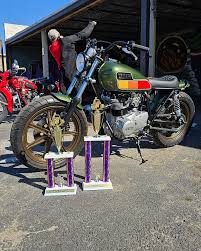
This build checks a lot of boxes for me, and ultimately inspired me to start my own build. In particular, I like the handlebars, seat, front and rear fenders, and the upswept seat hoop. Some things I would change are to keep the original airbox and side covers. Not only does that avoid needing to rejet the carbs, but I also prefer the look. Additionally, I prefer the wheels to be black, and it would also benefit from mirrors.
So, I started shopping for bikes. I scrolled Facebook marketplace every day for multiple months, going to see a couple of bikes, but never finding the one. I wasn’t specifically shopping for an XS400 either. I was open to any 70s or 80s bike, as long as it had the iconic Japanese Universal Motorcycle (JUM) look. I also specifically wanted it to have a kickstart (I don’t know why, but kickstarting a road bike is just so cool to me). I liked the idea of the XS750, or an older Suzuki GS or Honda CB, but none ever popped up in my price range. Eventually, an XS400 Special II came up, asking only $600CAD and only a 3-hour drive away. It didn’t run, and had been sitting for 17 years, but the price was right, it had a clean title, and ownership was in the seller’s possession. I went to see it and met the older couple selling it. It was the bike his wife learned to ride on. I offered $500CAD, and we settled at $550CAD.
 Side view of my XS400 when I bought it.
The Build
I got it home with the help of my uncle, who lives only a half-hour from the seller. I took it apart, cleaned the 17-year-old gas out of the tank and carburetors, and it fired right up!
I checked the cylinder walls with a boroscope, and they look fantastic, crosshatching and everything! I measured the compression, getting 120psi on the left and 125psi on the right. The engine is healthy and does not require a rebuild! The next step was really stripping it down. Removing all the parts I don’t intend to use in the final build, and cleaning the bike thoroughly (lots of mouse poo, yuck).
After a good cleaning, I removed the entire wiring harness. I plan to fully rewire the bike to run a modern reg/rec, headlight, and LED brake and turn signals. I also purchased a Motogadget mo unit blue to really modernize the bike with keyless ignition and the works.
Rewiring the Stator
At this point, I didn’t have a welder or angle grinder yet (for the frame modifications, seat hoop, etc.), and I still have a lot to do before I’m ready to begin wiring. So, I started some odd jobs. First on the list is fixing the small oil leak coming from the stator wire grommet. This is a common failure point on these bikes, and unfortunately, you can’t get a new grommet anywhere. Rewiring, and some silicone gasket maker, it is!
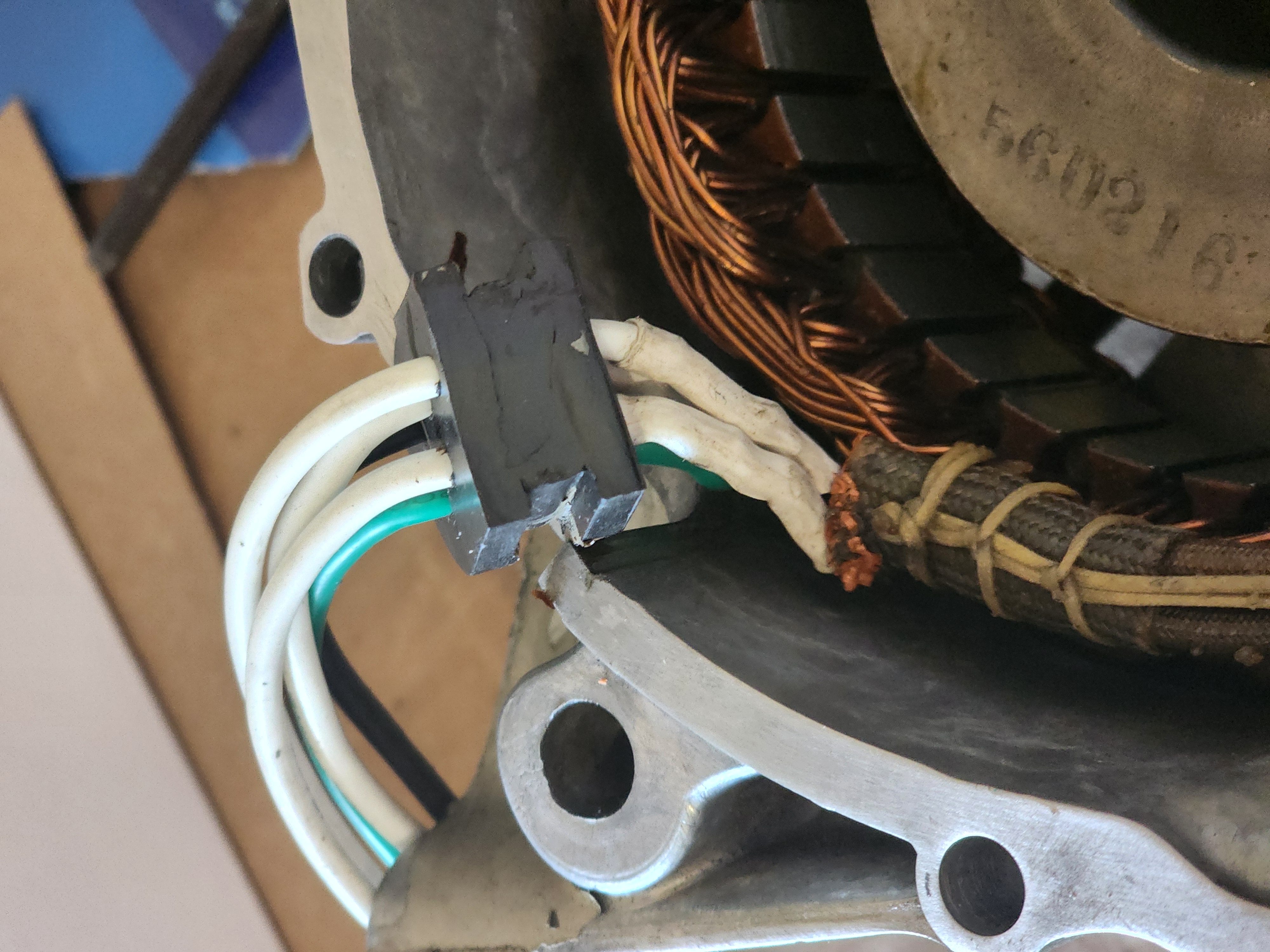 Rewired stator grommet.
I used 16AWG wire instead of the original 18AWG to ensure a tighter fit through the grommet, just to be safe. I applied a conservative amount of red RTV and reinstalled the stator.
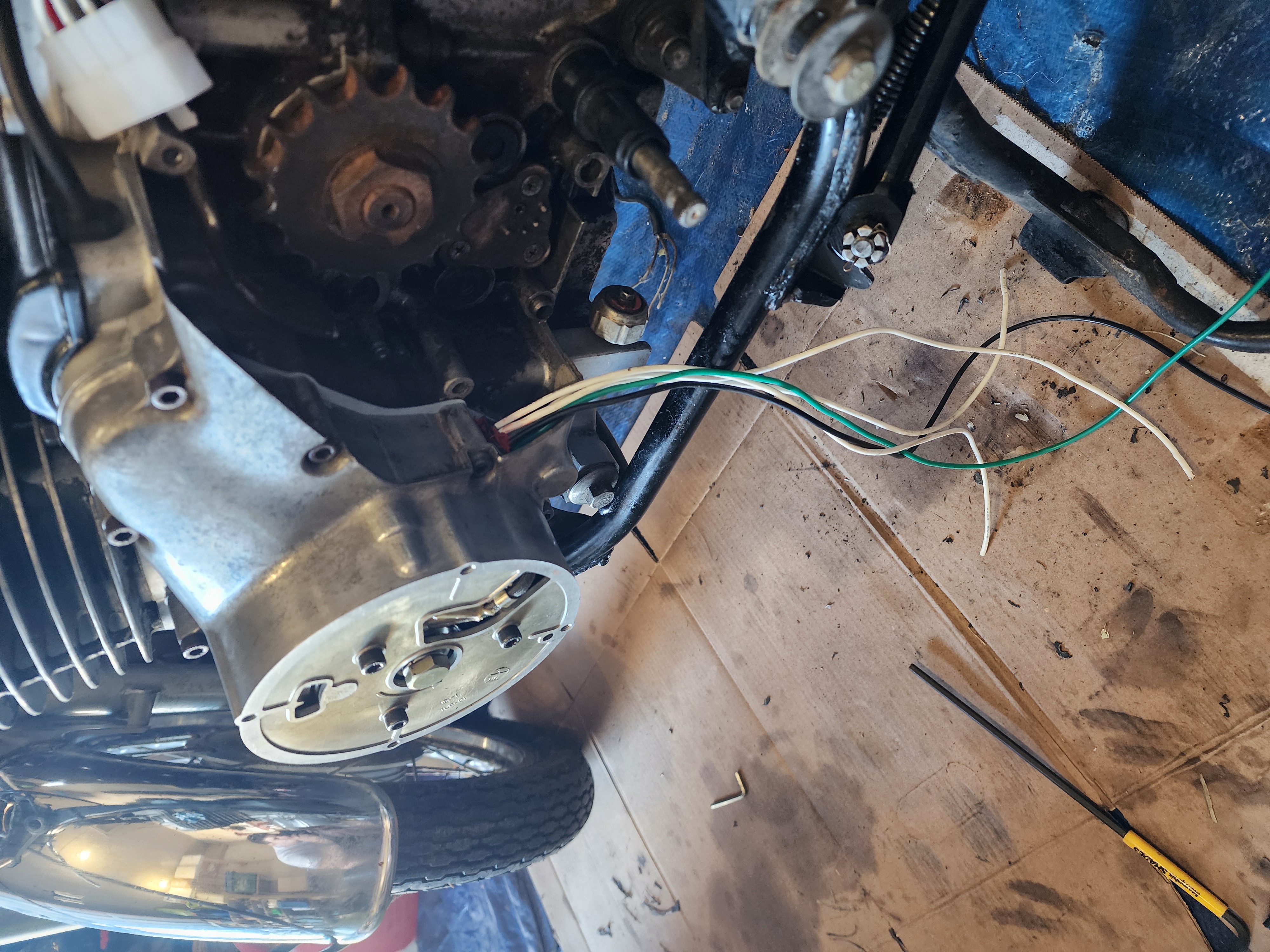 Rewired stator installed in the bike.
Polishing the Headers
Another small task I completed around this time was polishing the headers, as the pitting was not too severe. I used a red Scotch-Brite pad and metal polishing compound on most of the pipe, but used the heavy-duty green pad for the worst of the pitting. They turned out just perfect!
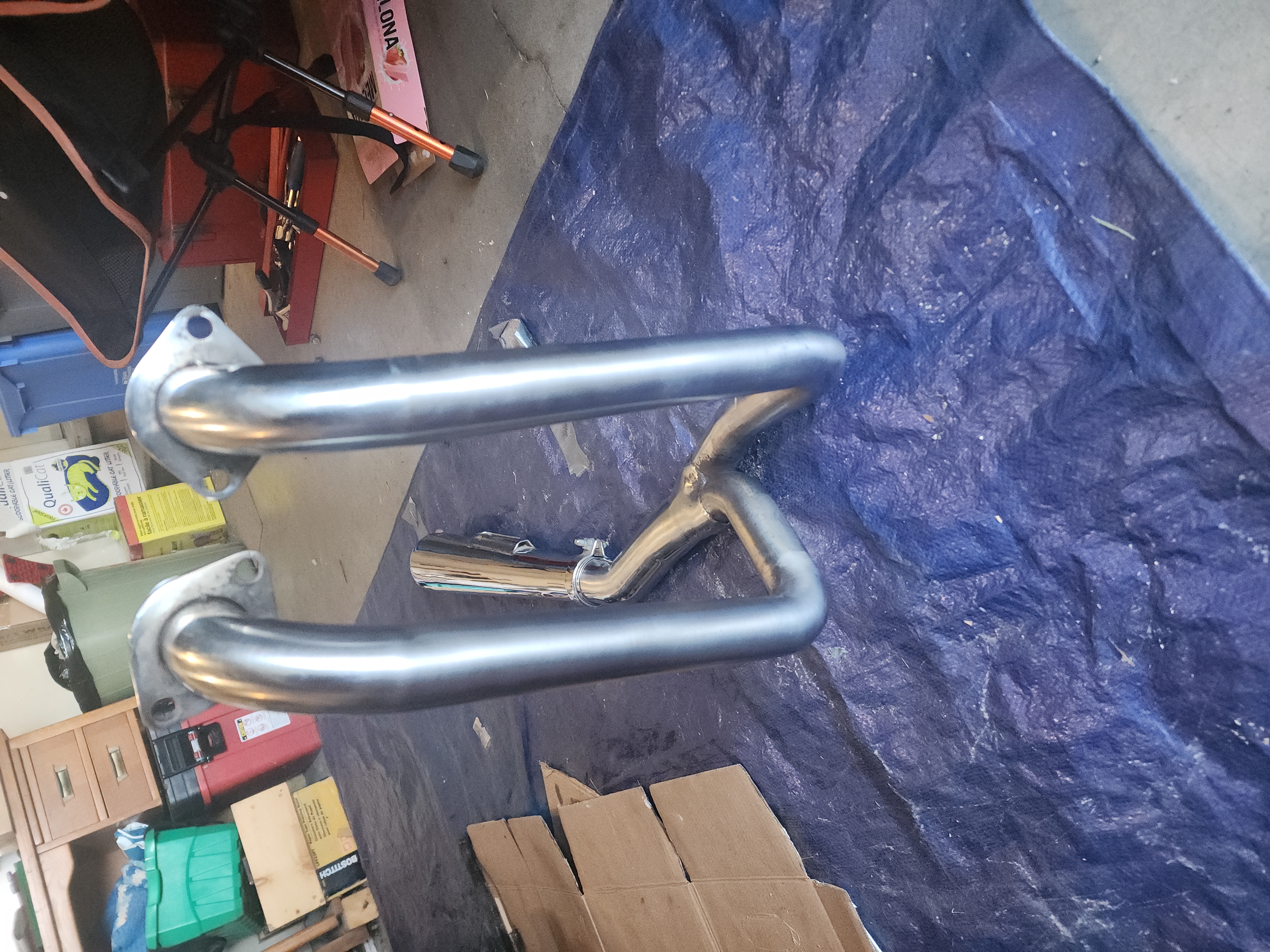 The polished headers.
Upgrading the Headlight
Continuing with the small jobs, I upgraded the original headlight sealed beam unit to a modern H4 replaceable bulb. This was a bit of a funny process, involving the smashing of the original bulb to get it out, and some careful Dremel work to make the modern bulb fit nicely. I bent the tabs on the bulb and used some more red RTV as some glue to make sure it doesn’t vibrate itself loose.
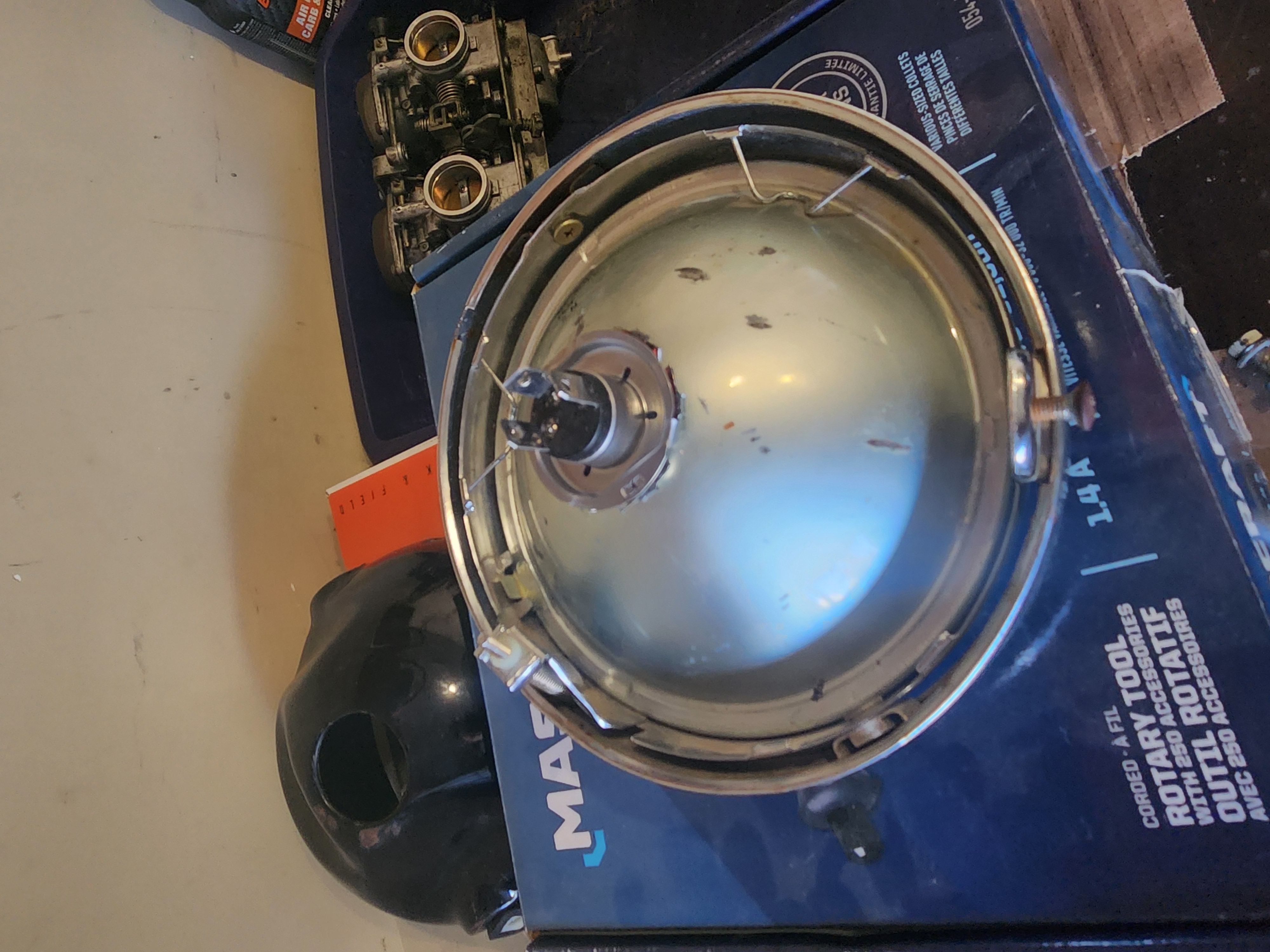 The modified headlight unit.
Painting Assorted Parts (Nov, 2025)
Every so often, when I got the chance, I scuffed, cleaned, and painted parts I intended on reusing. Such as foot pegs, shifter pedal, rear brake pedal, and the hand levers. I also painted the headlight bucket and battery tray, and the rear drum. It’s not included in the image, but I also painted the kickstand and rear drum support.
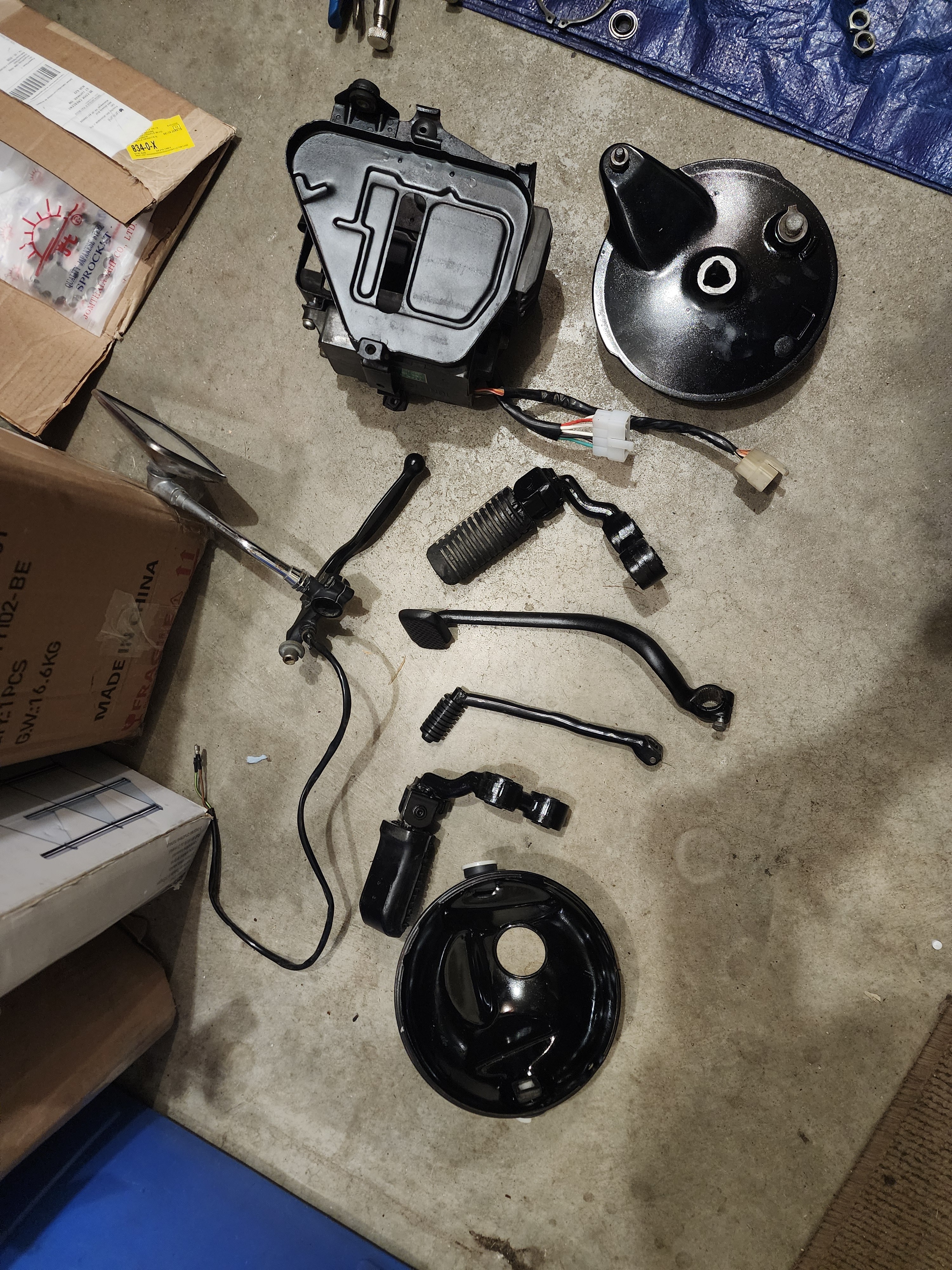 Assorted parts I painted.
Next, I painted the rear wheel. It had some pitting in the chrome, but nothing some scotchbrite and Brakleen couldn’t handle. The before and after are amazing! The paint I used is just the cheap gloss black rust paint from Canadian Tire, and some clear coat. I did a couple of coats of each.
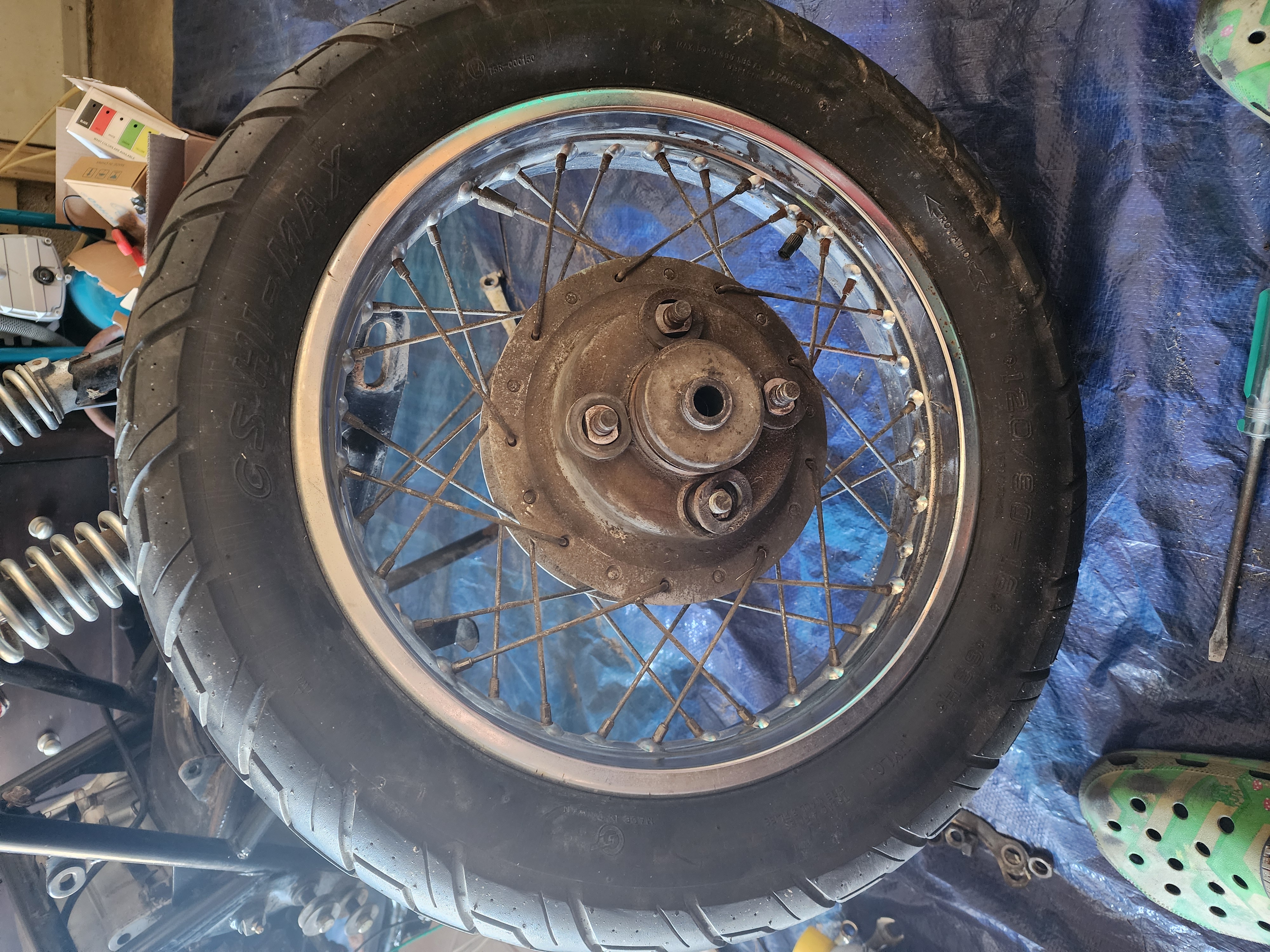 The rear wheel before prep.
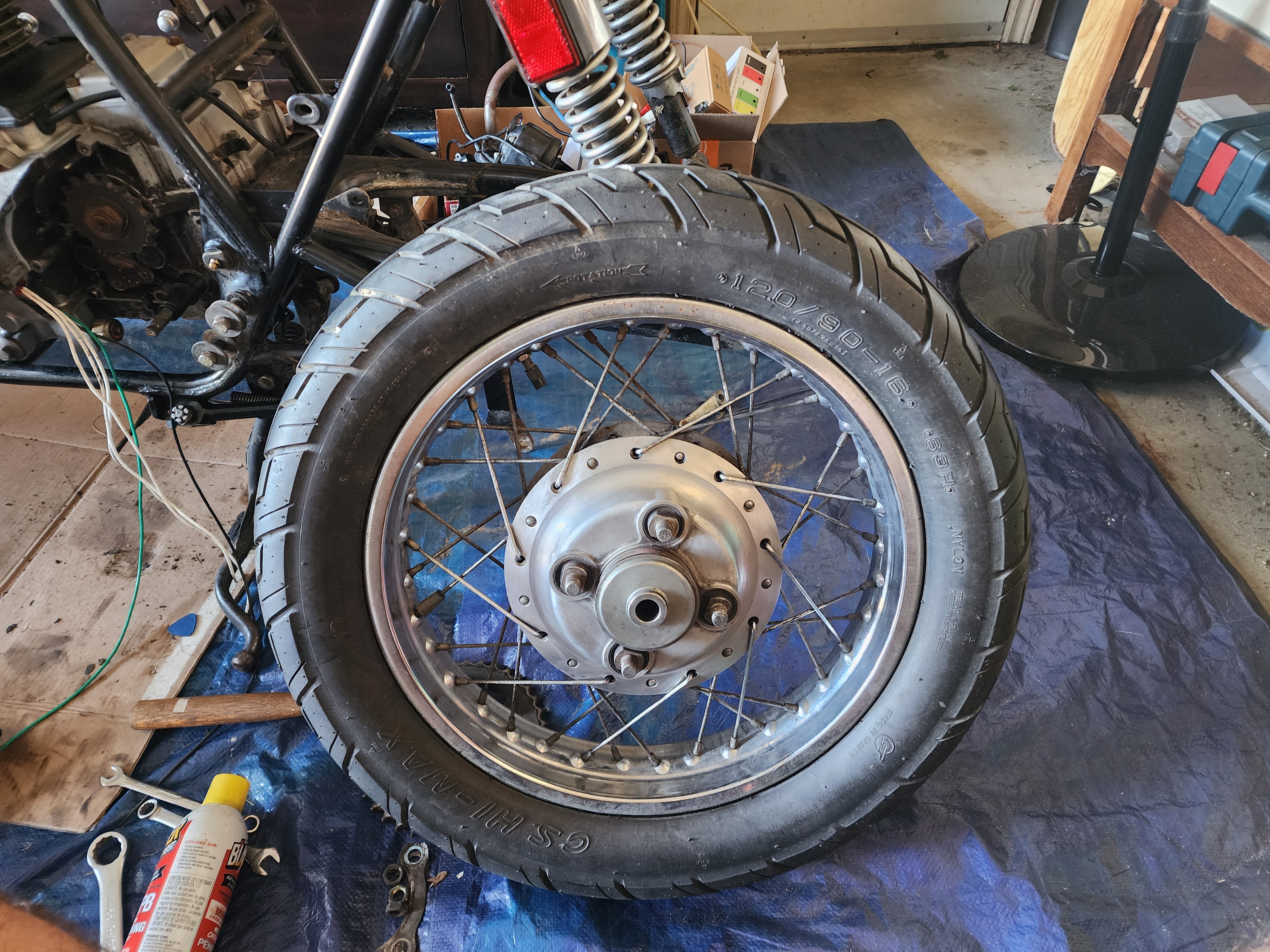 The rear wheel after prep.
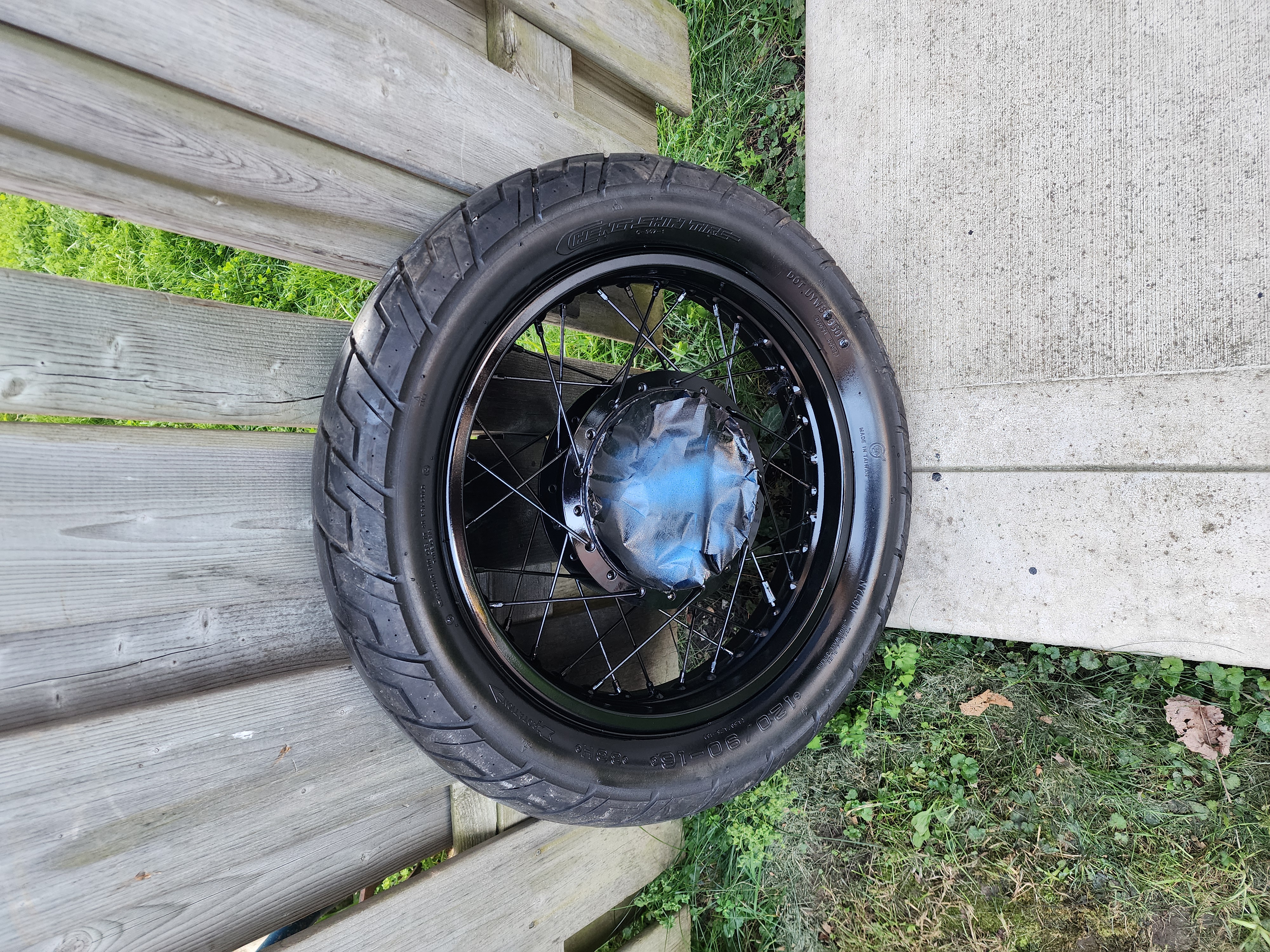 The rear wheel after painting.
Finally, before putting the wheel back on, I figured a new sprocket couldn’t hurt. This involved buying a sprocket kit from eBay, as well as some NOS retaining washers to make sure the sprocket nuts don’t come undone. I also had to buy a set of snap ring pliers to get the snap ring back on (getting it off was easy enough with a pair of pliers and a screwdriver, but I couldn’t get it back on the same way).
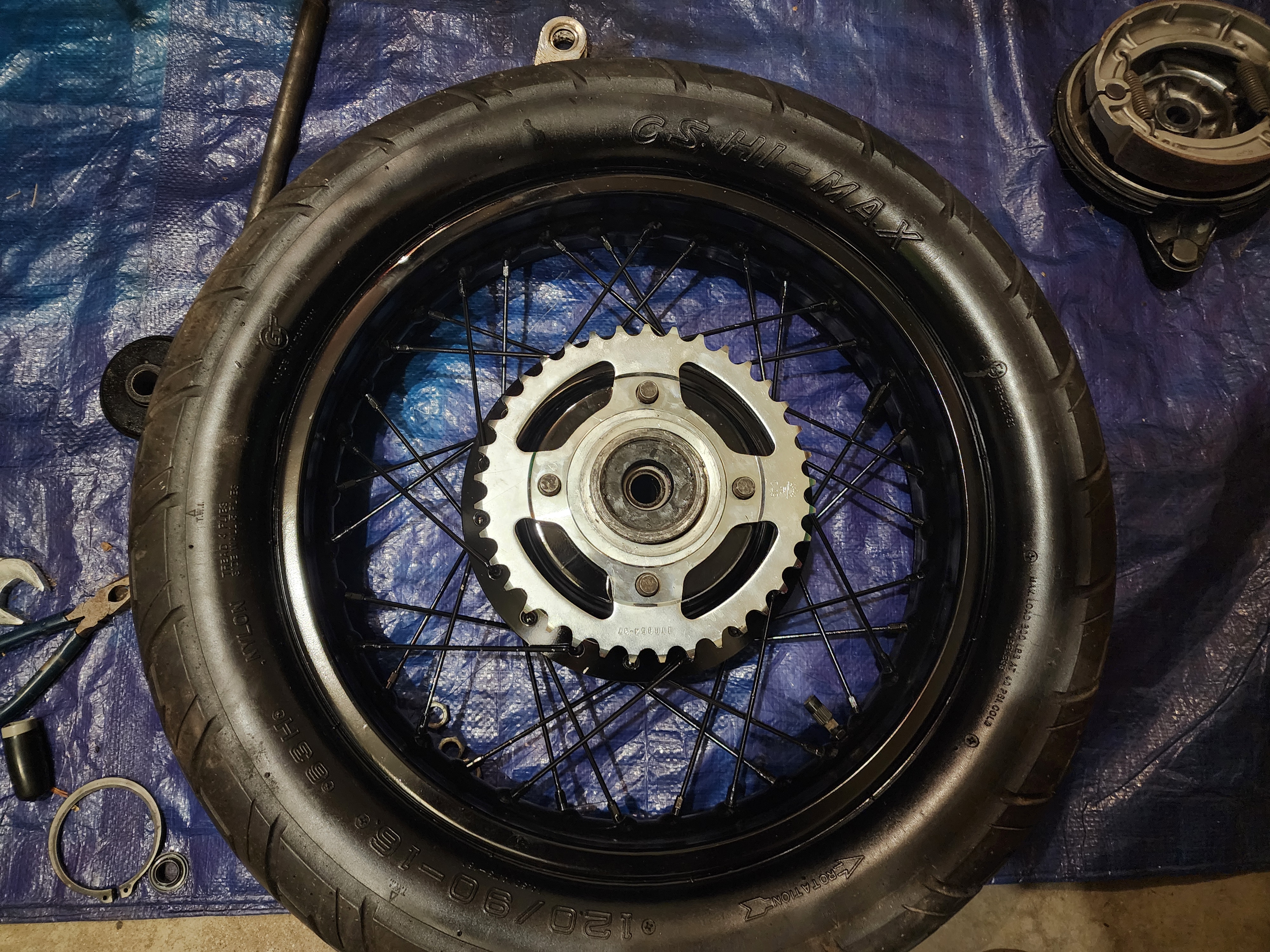 New sprocket.
And here is the wheel, with its new sprocket, installed back on the bike. I had my brother hold up the wheel while I put the axle through all the bits, with a light coat of antiseize brushed on.
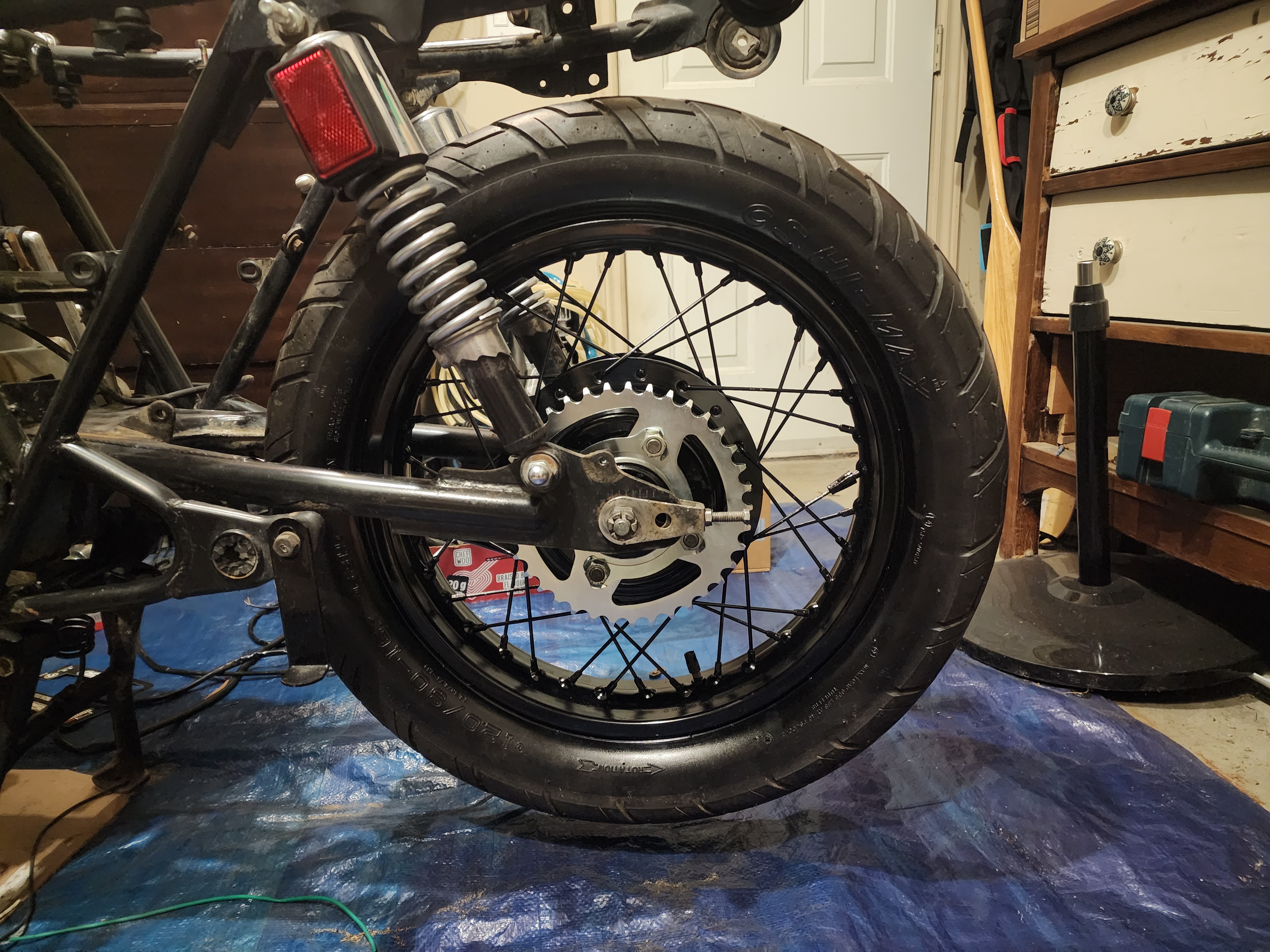 The finished rear wheel back on the bike.
The next items on the painting hit-list are the front wheel and fork bodies. To remove the front wheel, I started by removing the fender, then disconnected the brake linkage. After that, I undid the two bolts on the left fork holding the axle, and hammered it out. Overall, the front wheel was much cleaner than the rear.
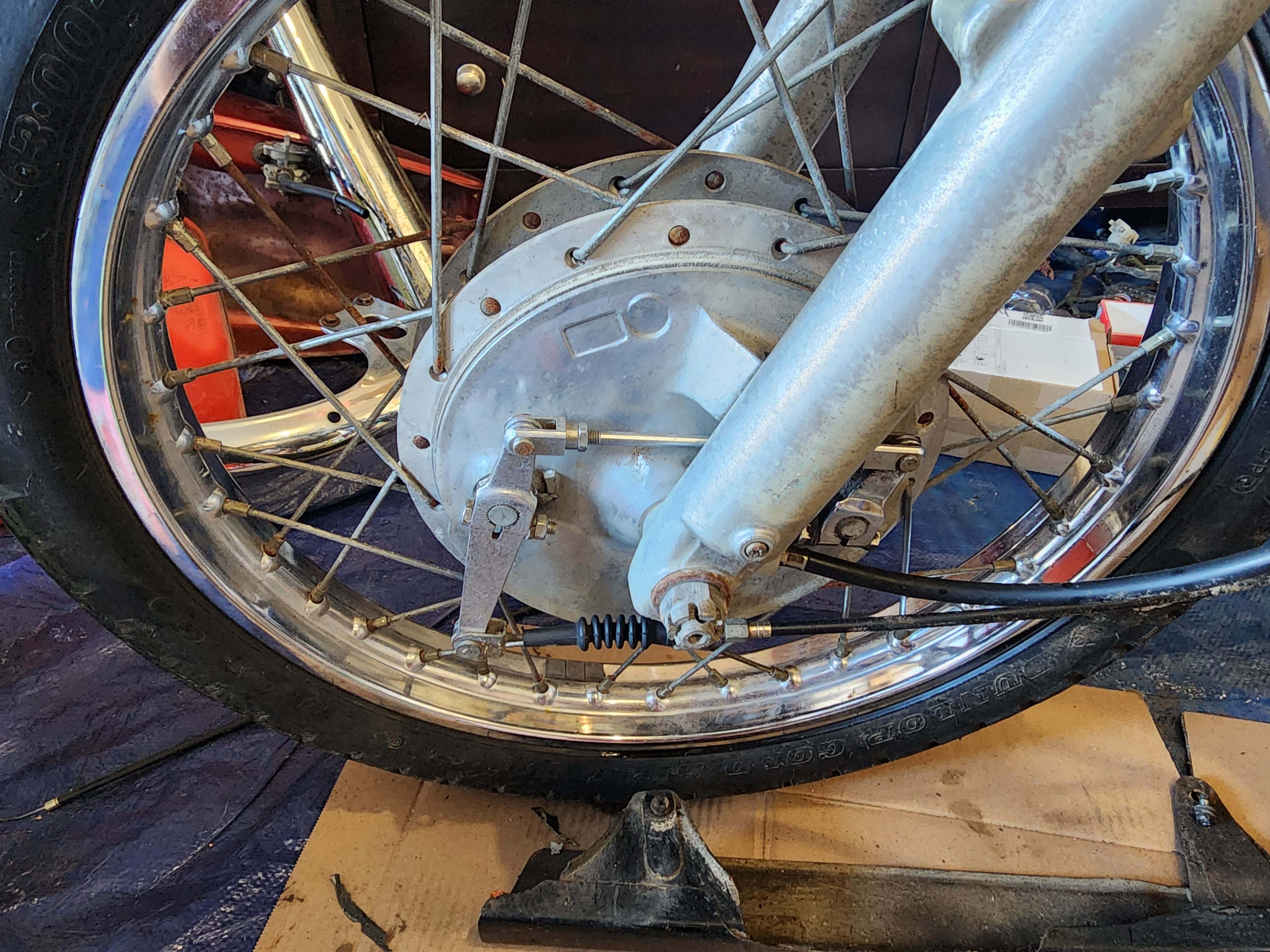 The front wheel before disassembly.
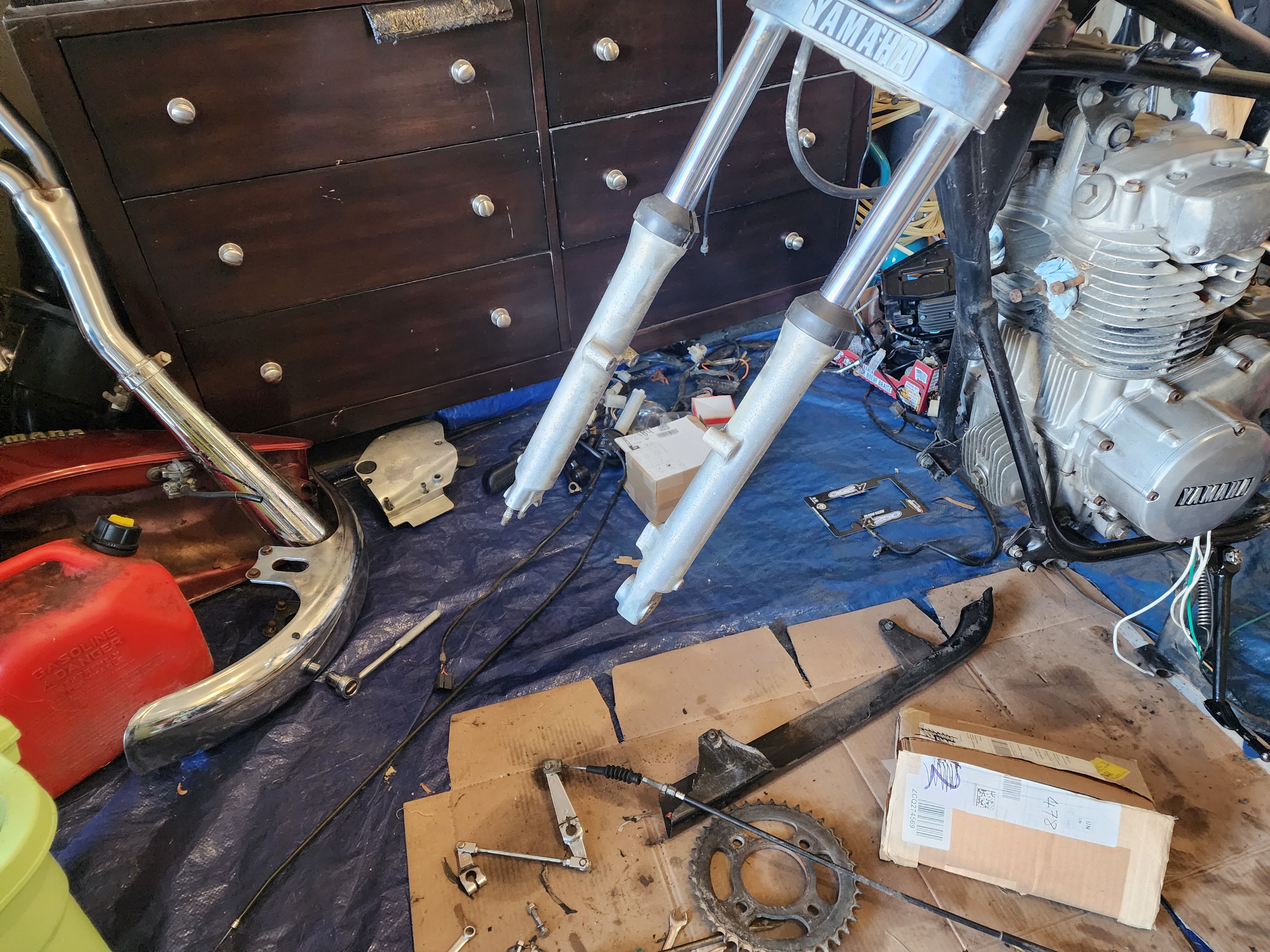 The front wheel-less forks!.
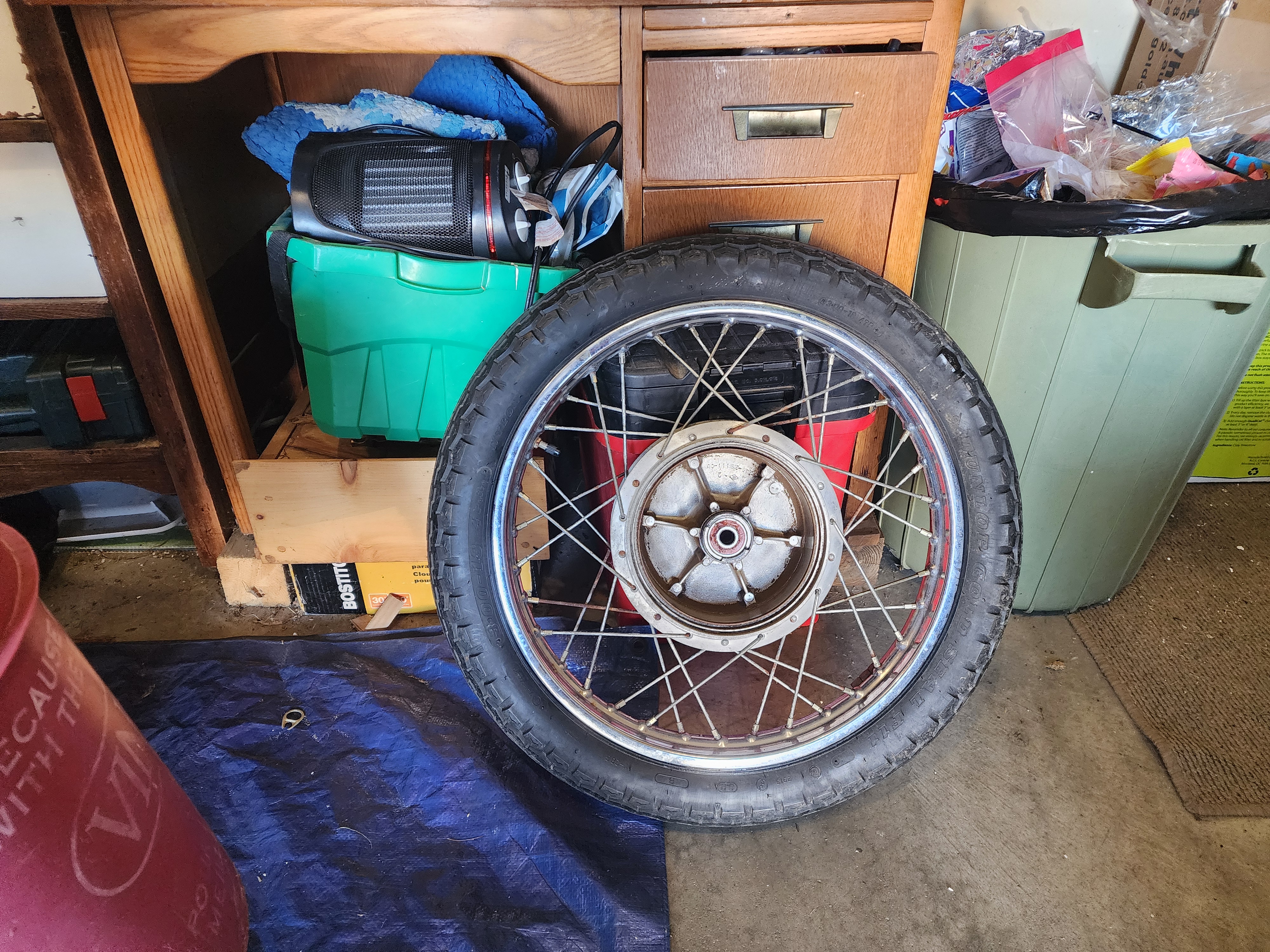 The front wheel all alone :(.
The front wheel painting was the same as the rear wheel, though a bit faster, as there was less grime (no chain lube gathering road goo). Just a thorough clean with Brakleen, then soap and water, scuff with Scotchbrite, and a final rinse with water. The temperature outside was getting too cold for paint, so there were some issues with getting the paint to stick. I think it still turned out all right.
 Front drum brake housing painted.
 Front wheel painted (1).
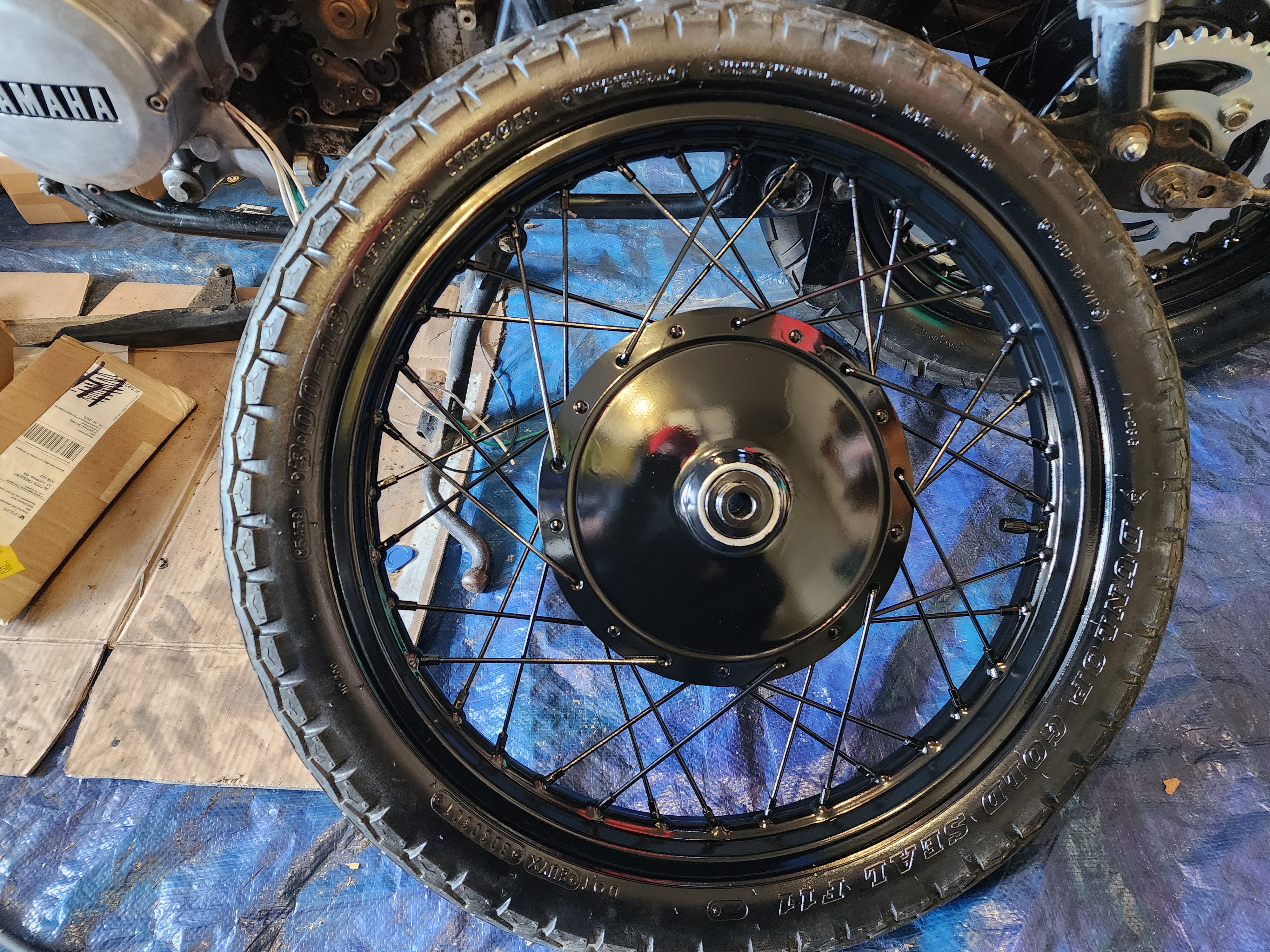 Front wheel painted (2).
There were a couple of weeks where we got some snow (The gales of November came early), so painting was off the table. I decided to do an initial mockup of the controls, cut the throttle cable to length, etc. I chose some orange grips to match the future color of the bike!
 Control mockup left.
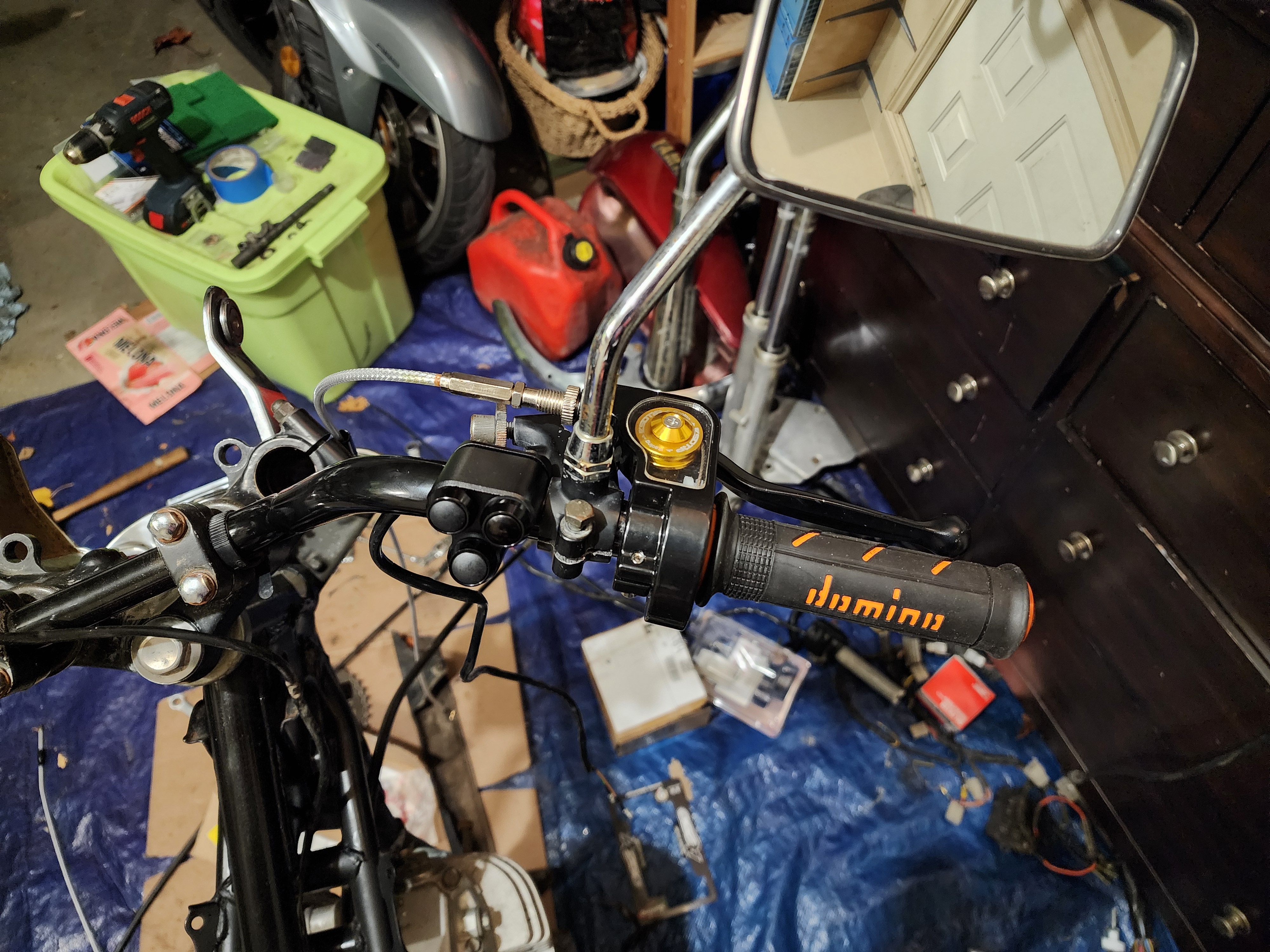 Control mockup right.
Rebuilding the forks (Feb, 2026)
After a significant break while my responsibilities as a graduate student took priority, and indoor track season started to ramp up, I finally got back to working on the bike. The job I took on was rebuilding the forks, which is a messy and tedious job. Thankfully, there is a lovely video on YouTube that shows in great detail how to complete this job, so I followed it.
The first step is to remove the forks from the bike and drain the oil out of the small drain hole sealed with a JIS screw and copper crush washer.
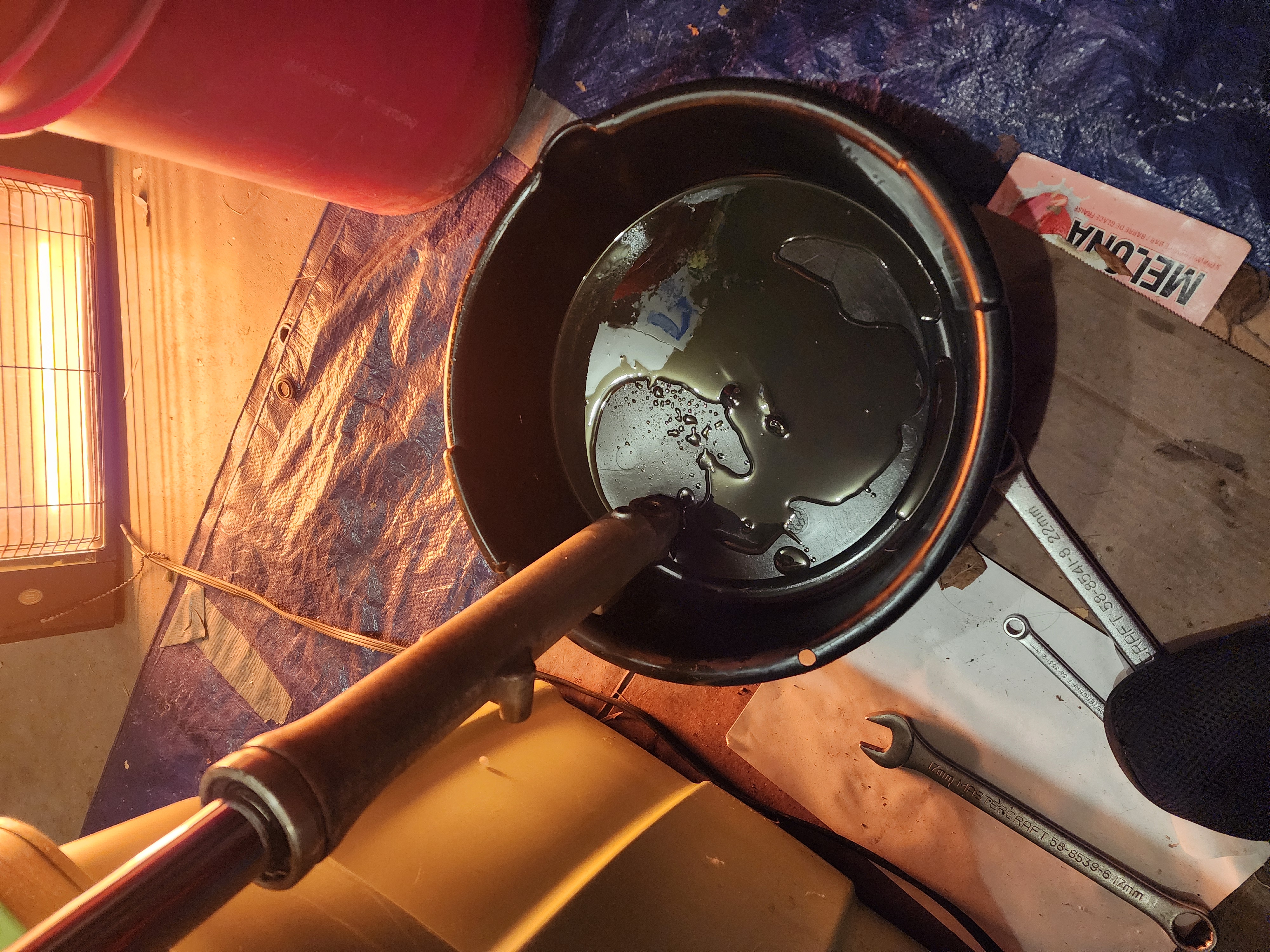 Draining the forks.
The left fork oil was quite dark and had a bit of a fishy smell. I suspect that the fork seal had started to go on this side, and that the oil was likely the original oil from the 80s (yikes!). The right fork was different, with relatively clean-looking oil and less smell. The oil had either been replaced before (which would be strange… Wouldn’t you just do both at the same time?), or the difference was just in the seals. Maybe the right one did a better job keeping the gunk out.
The next step is to open up the forks. This is done by removing the small plastic cap, pressing down on the plunger at the top of the fork with a large screwdriver, and picking out the small circlip that stops the plunger from shooting out the top of the fork under the pressure from the spring. The guy in the video recommended putting the fork back on the bike to hold it in place while you do this, in case you don’t have a vice (which I do not).
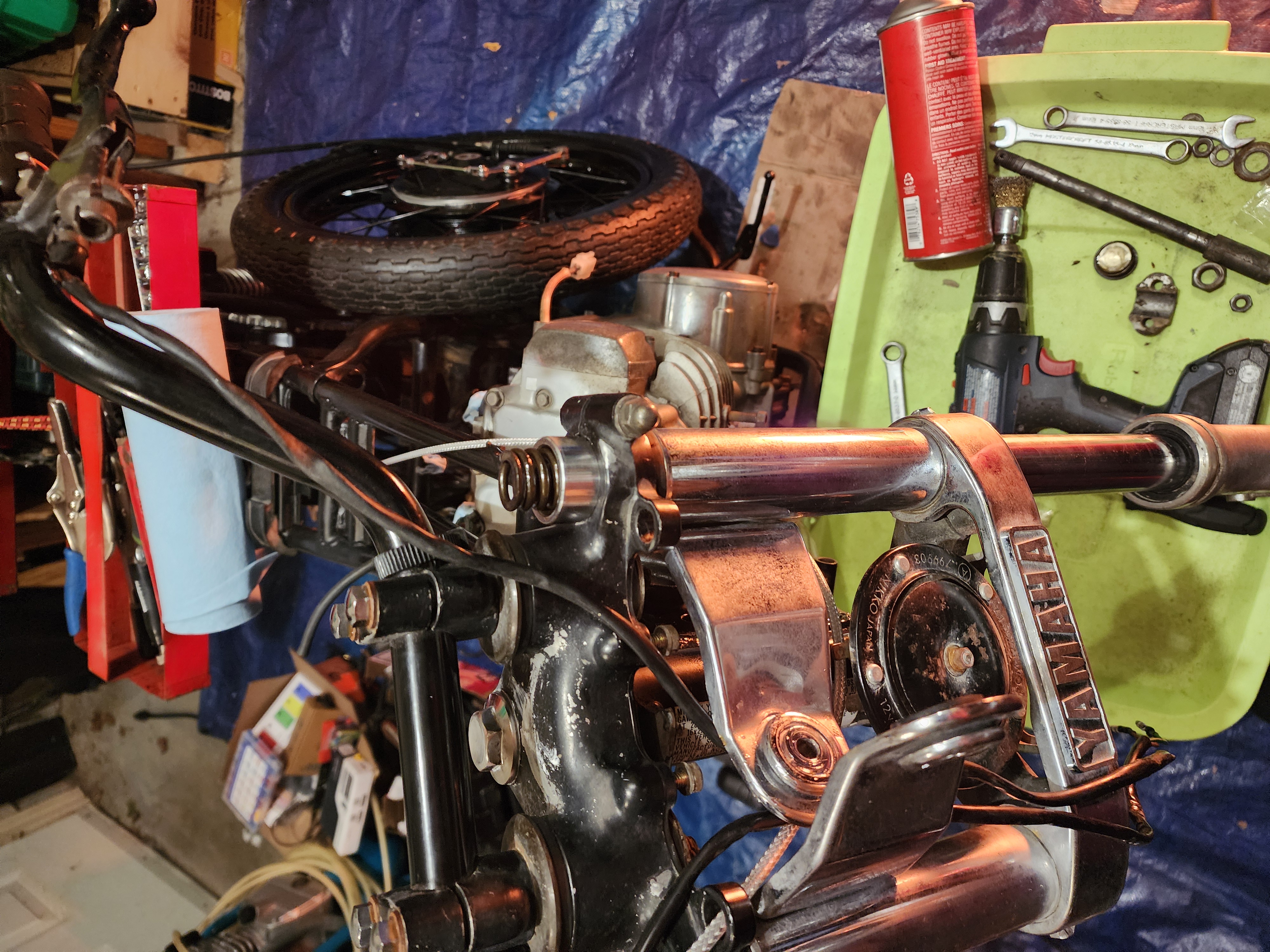 The opened up fork.
Getting that little circlip out while pressing down on the plunger with the other hand is a huge pain in the ass, and was by far the hardest part of this job. Here’s a picture of the little bugger:
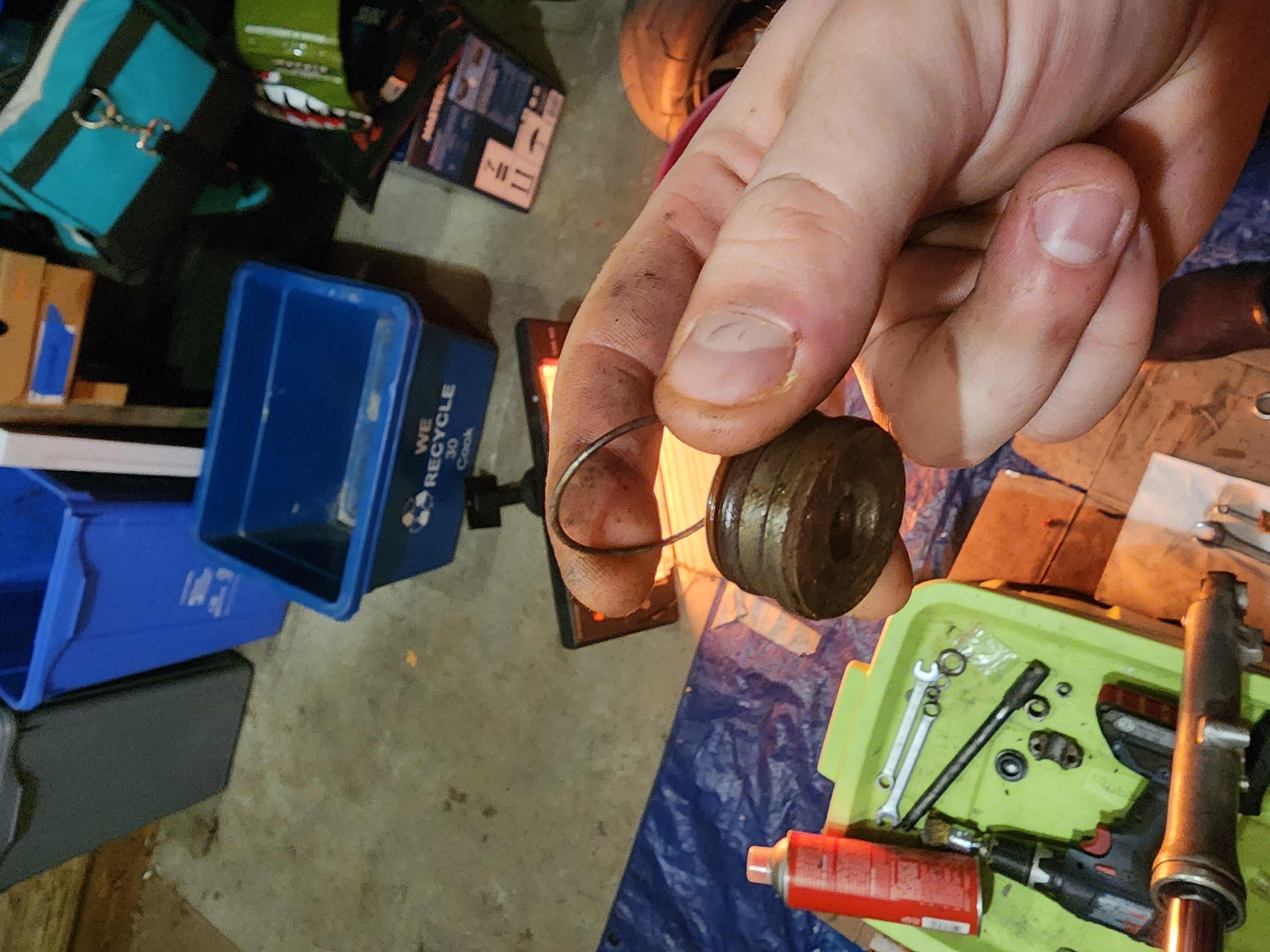 The fork plunger and circlip.
After this, the forks can be fully dismantled by taking out one last bolt from the bottom. It was pretty cool seeing the inner workings of a fork, but this is the messiest part of the job. I placed down some shop towels to soak up any leftover oil.
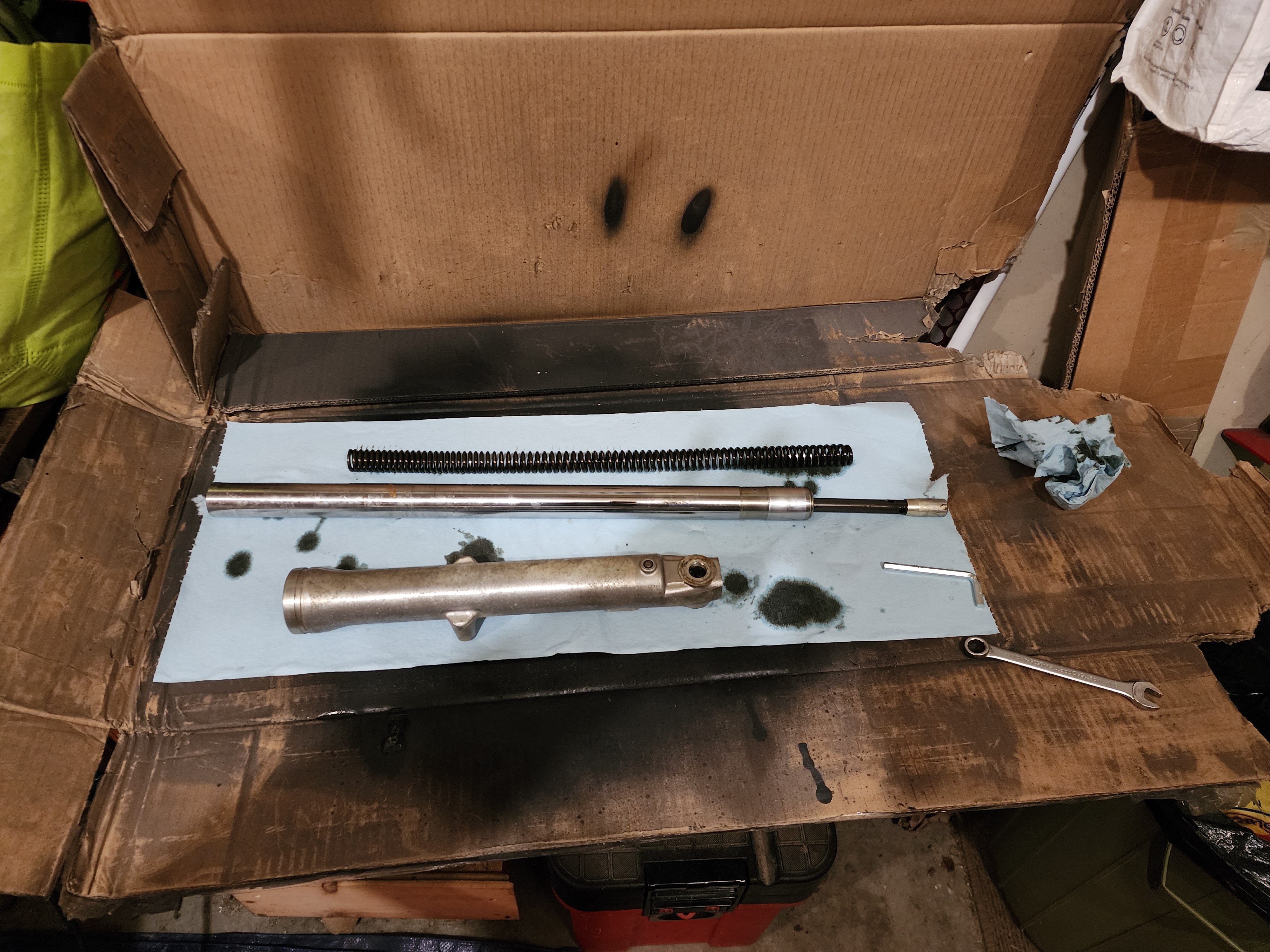 A fork fully disassembled
Next, I cleaned them up and replaced the fork seals. To remove the old ones, you just pry them out with a big screwdriver, being careful not to scratch the sealing surface on the housing. Then, you gently press the new ones in and, using a big socket and a mallet, lightly tap it until it is fully seated.
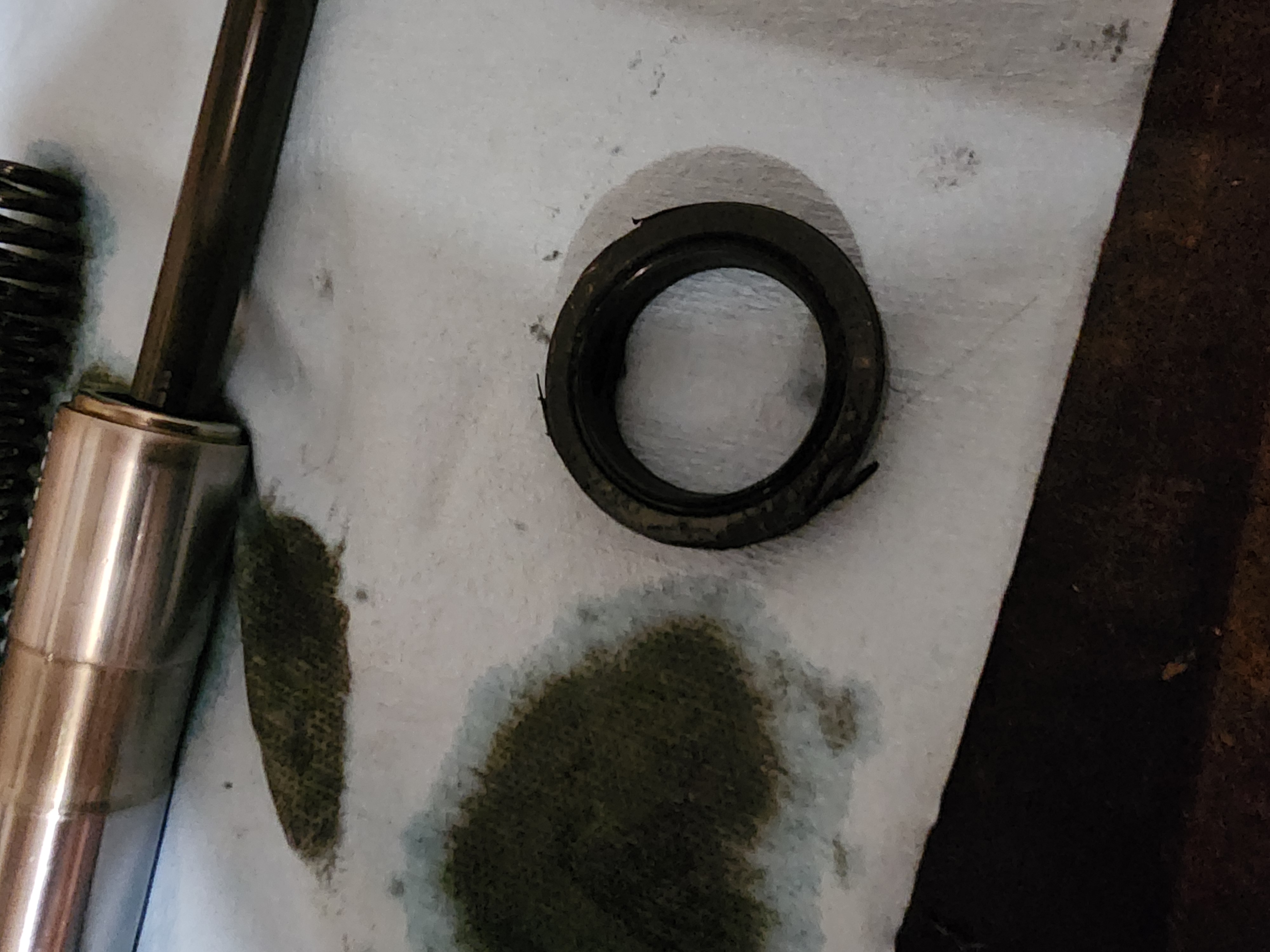
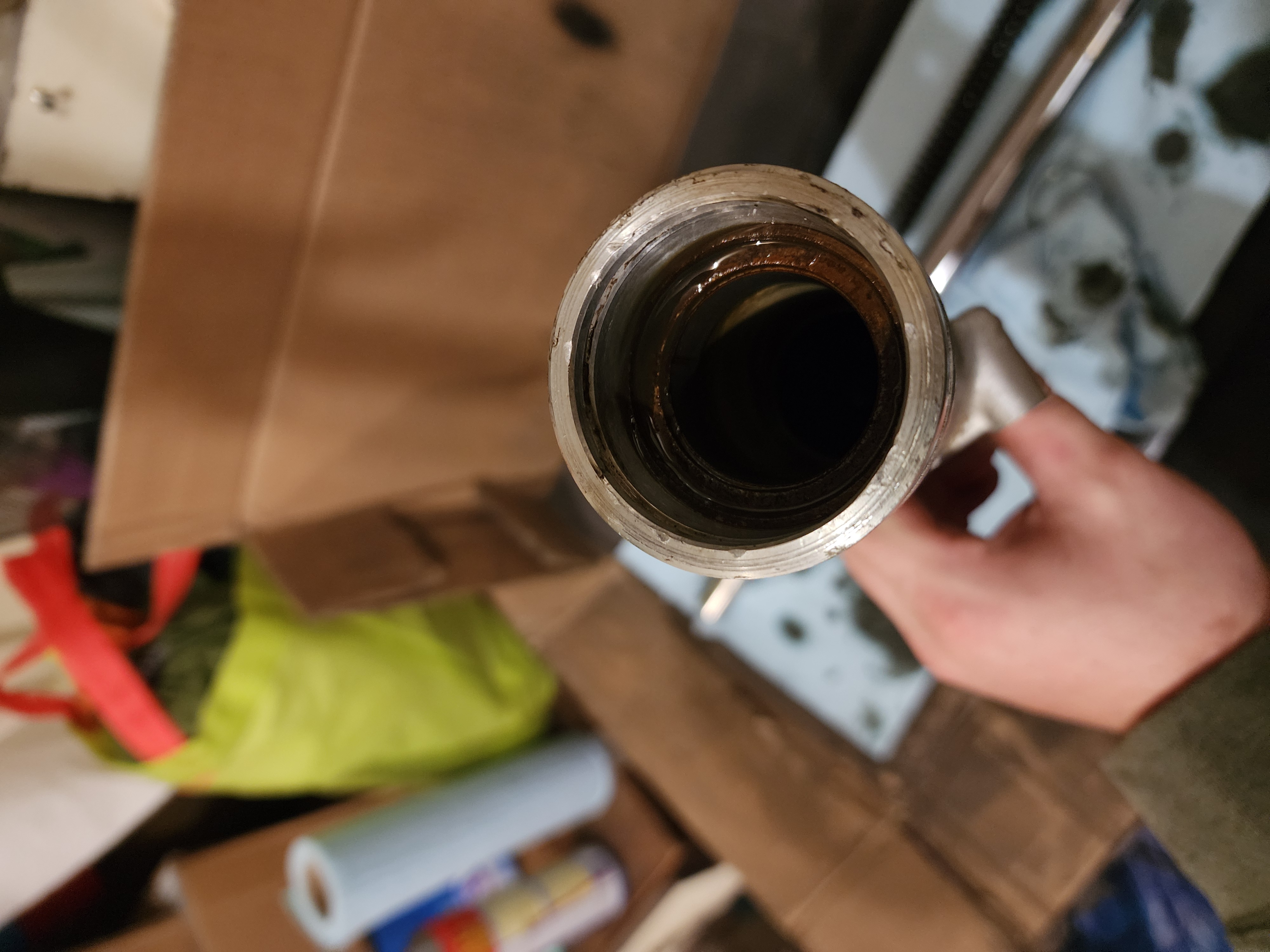
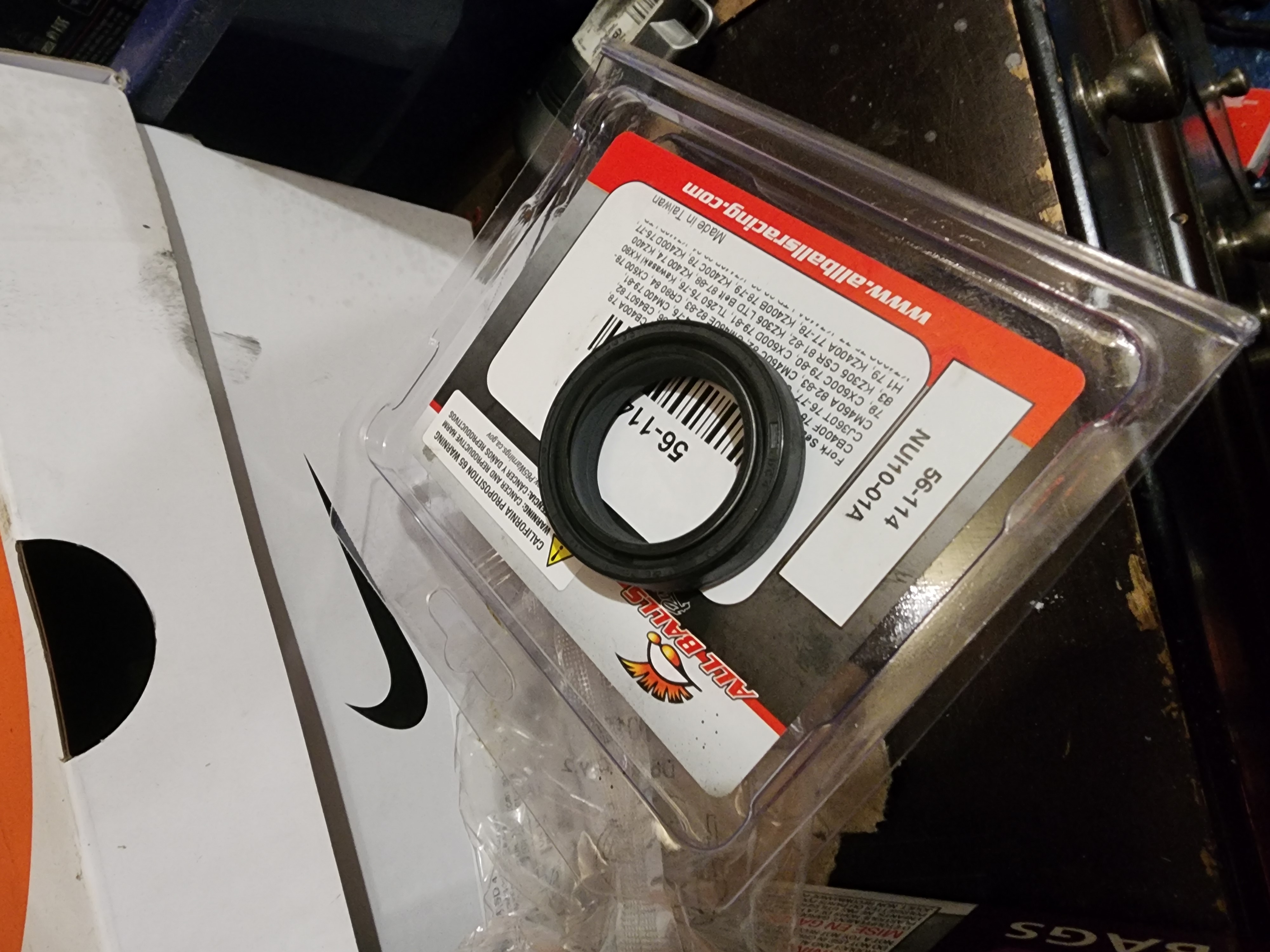
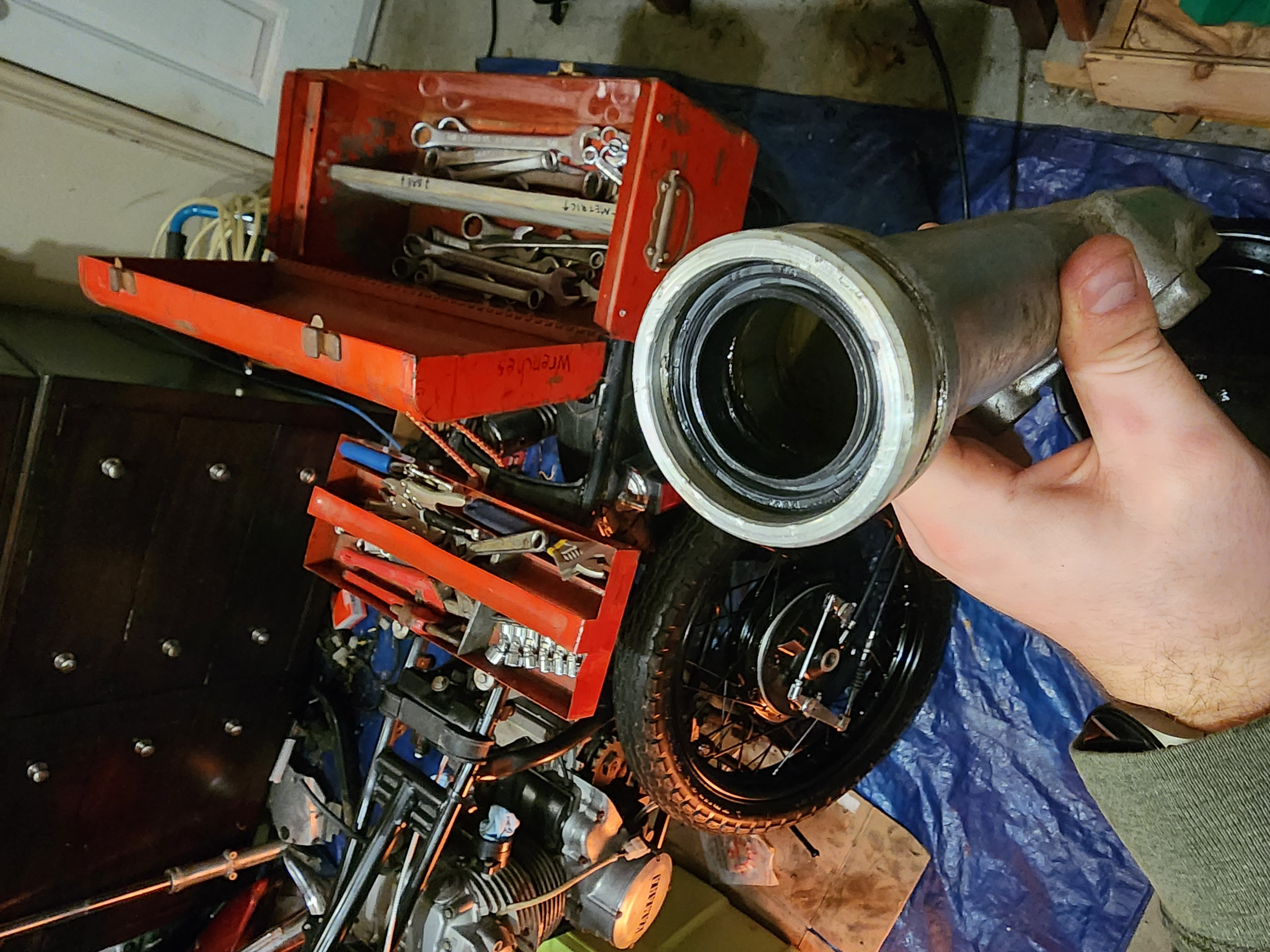
Finally, the forks can be reassembled in the reverse order of disassembly and installed back on the bike. As a 260lb man, I decided to use heavier fork oil to hopefully avoid bottoming out these poor little forks. I’ll see if it is beneficial, or if it just makes the suspension too stiff. I can always drain the oil and fill it back up with lighter oil. I was intending to paint the fork bodies black while they were off the bike, but the weather was far too cold. I’m quite liking the look of mixed silver and black, so I’m gonna give it a chance for now, and can always take them back off for painting later.
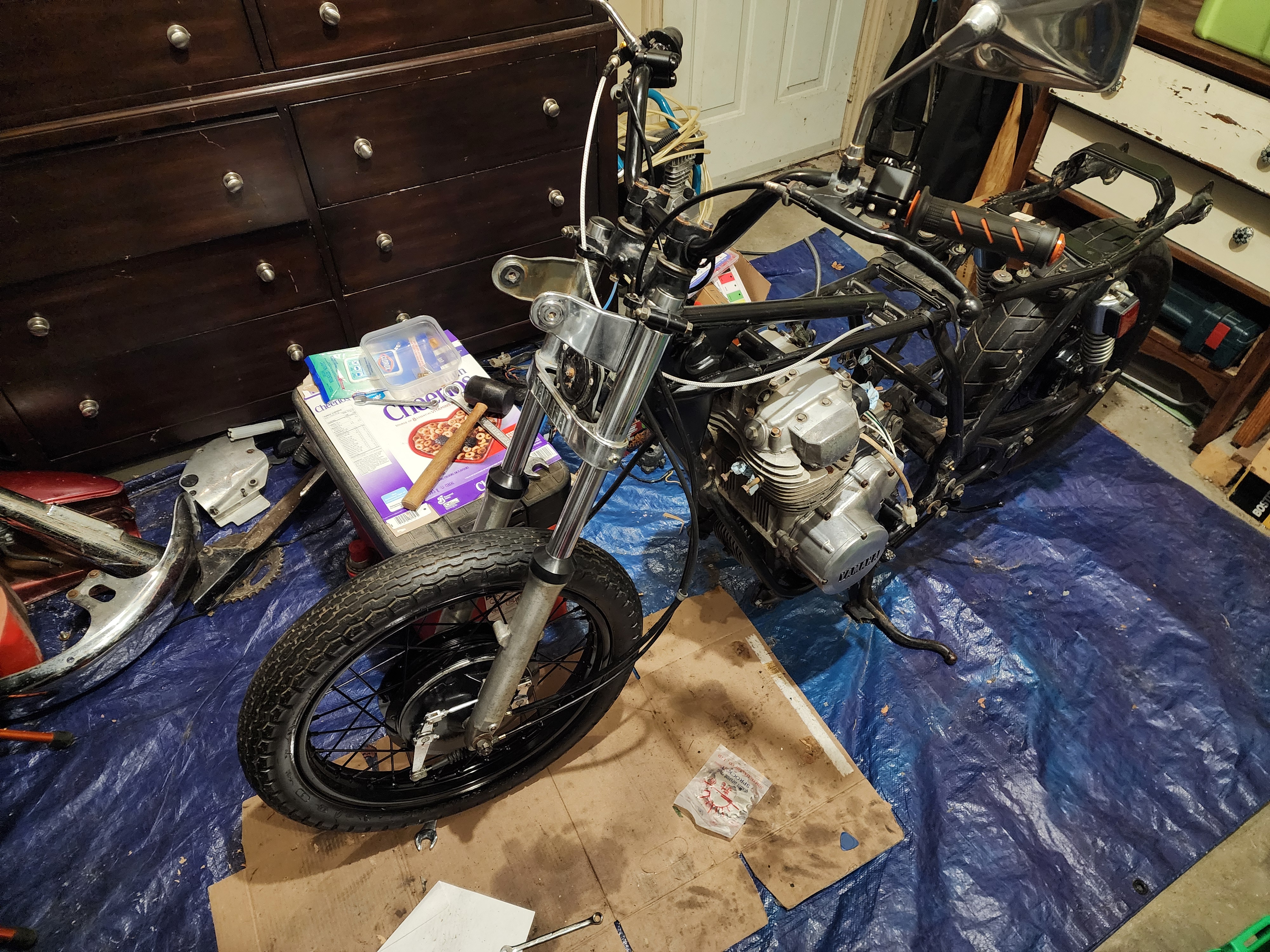 The rebuilt forks back on the bike.
Chopping The Frame (Mar 2026)
Making the modifications to the frame of the bike is the scariest part of this build for me. I have used an angle grinder before at work, but I did not own one myself, so I had to buy one. My dad bought me a small flux core welder for Christmas (2025), and I had to learn how to use it.
Before going after the frame of the bike, I practiced on the factory front fender of the bike. Since I’m going for a cafe/brat style resto-mod, I needed it to be quite a bit shorter. I drew my desired lines using a Sharpie and some yarn, then went at it with the cutoff wheel.
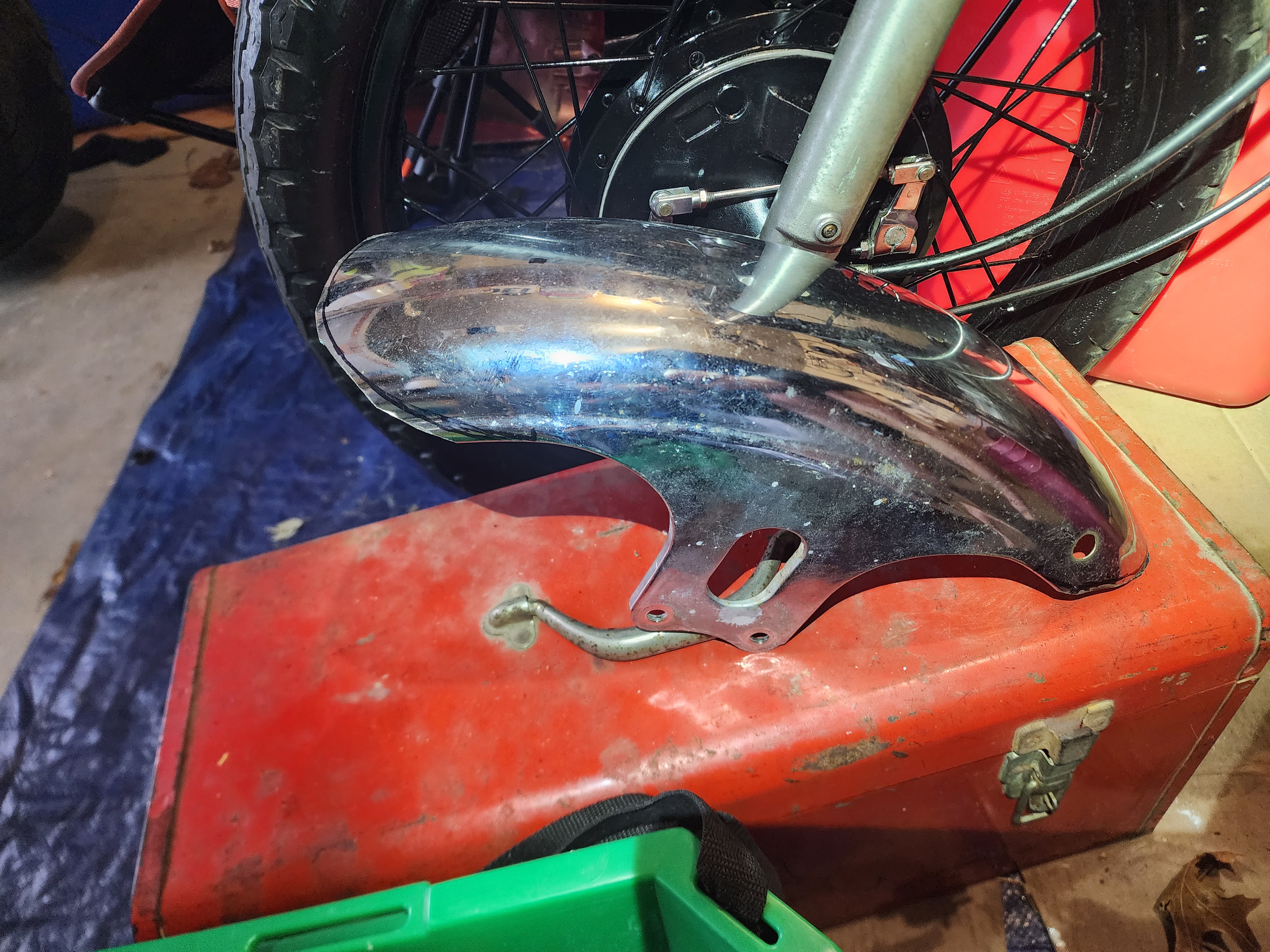 The front fender roughly trimmed.
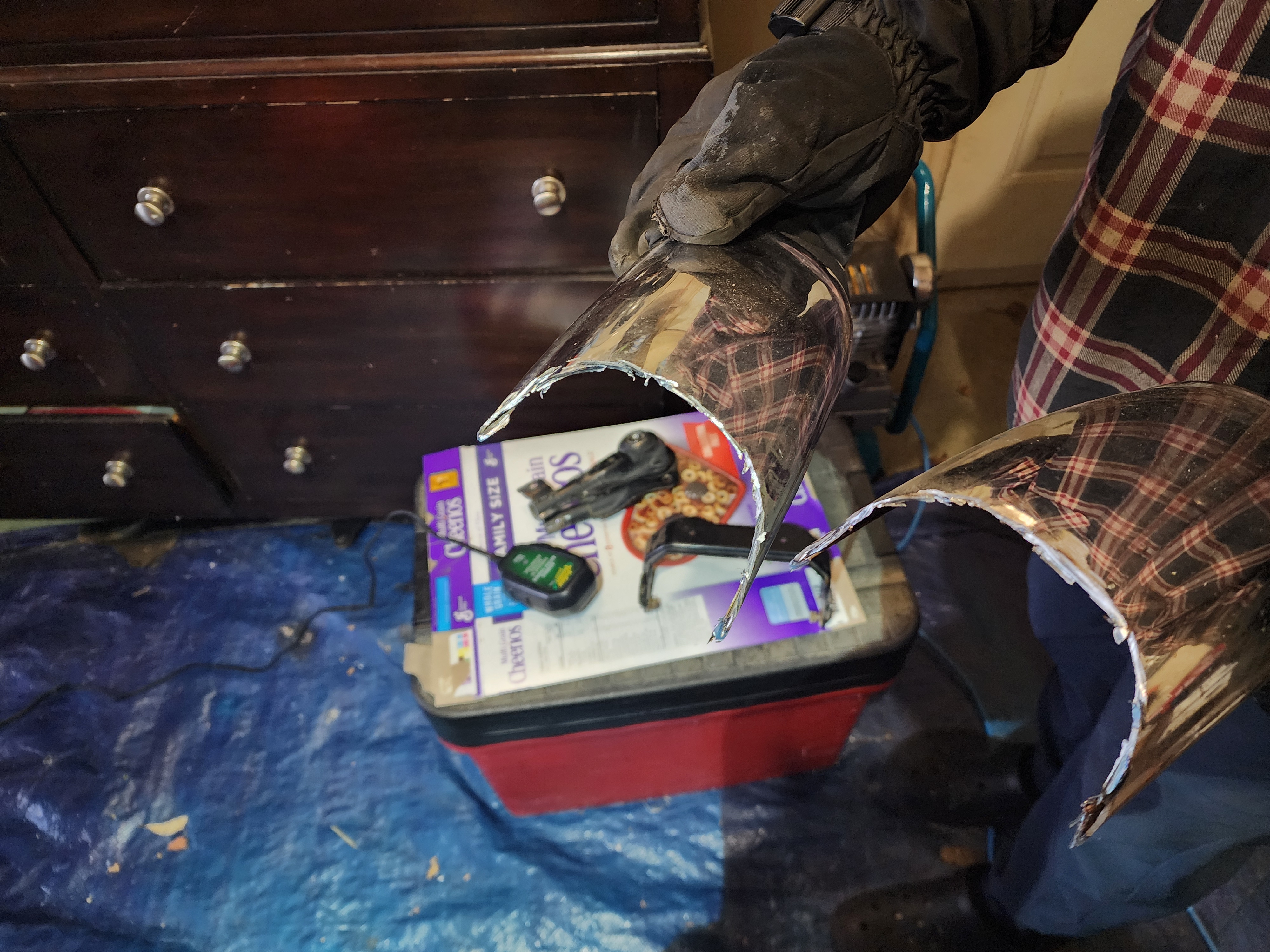 The “leftovers” of the mutilated fender.
Next, I chopped the frame, ensuring that I cut the frame evenly on both sides and as straight as possible.
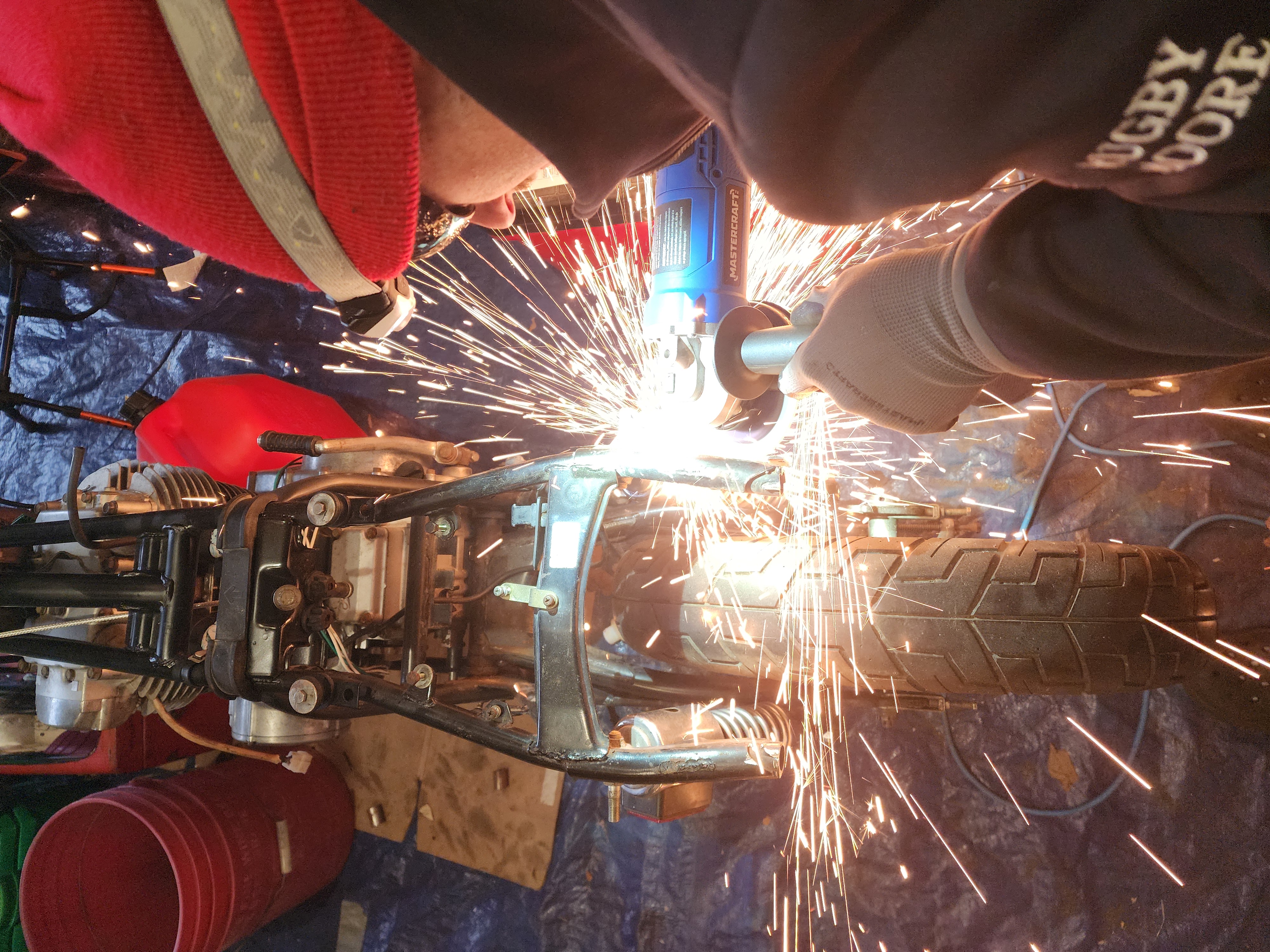 Me chopping the frame.
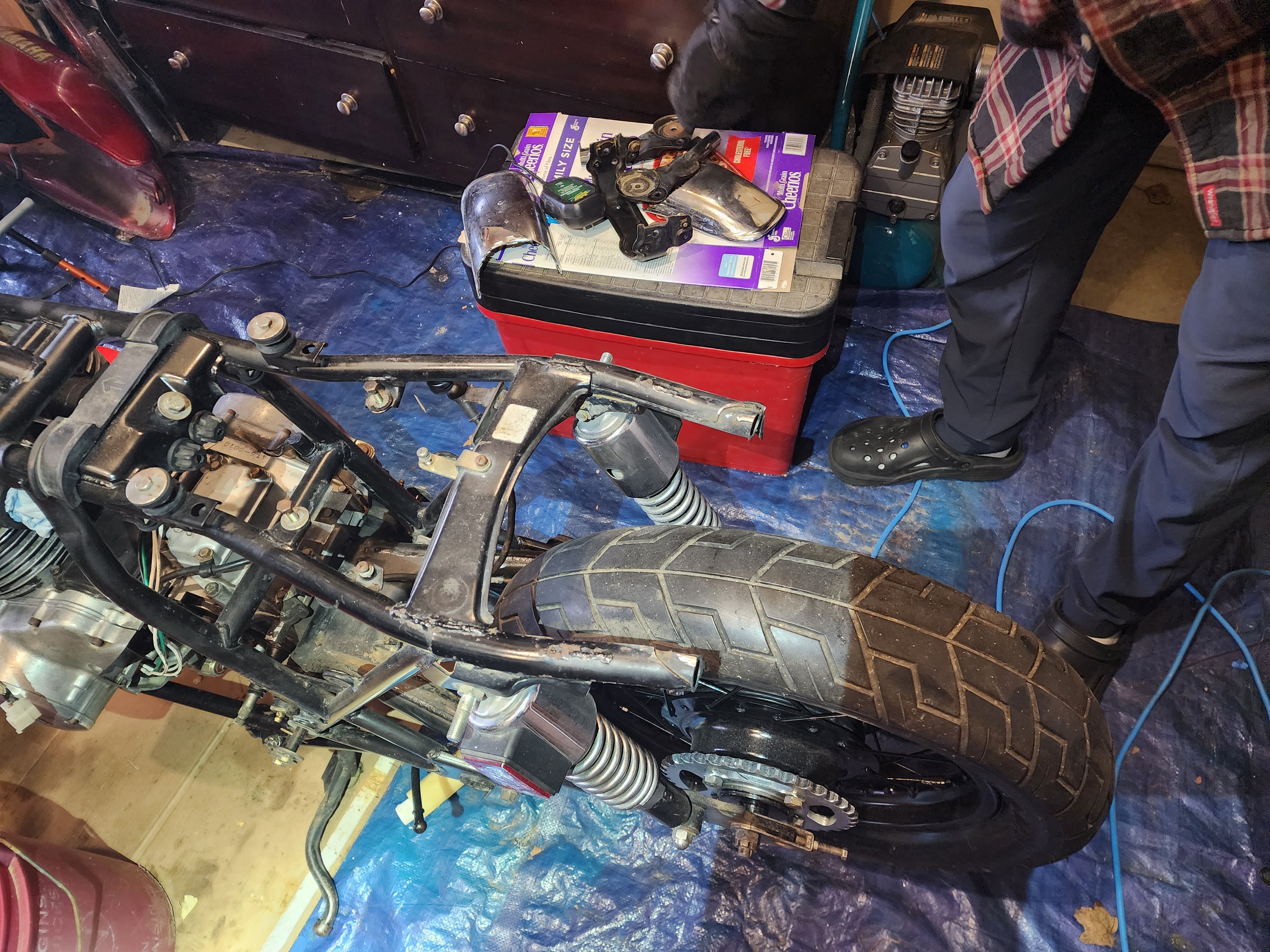 The chopped frame.
I also trimmed the hoop such that the frame will terminate at my desired length. Finally, it is time to practice some welding. I had never welded before, so I did a few practice runs on the scrap pieces from chopping the frame and hoop.
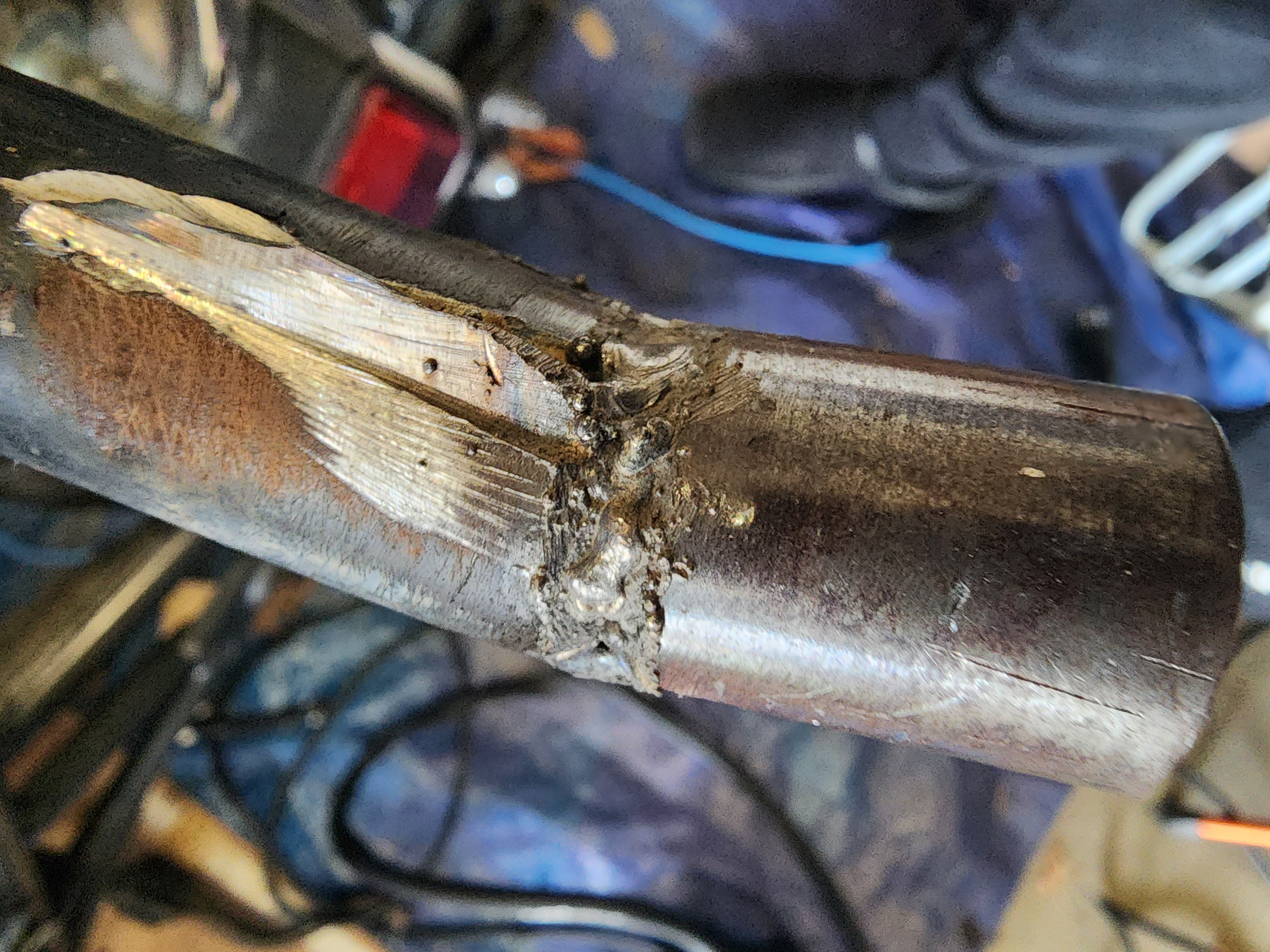
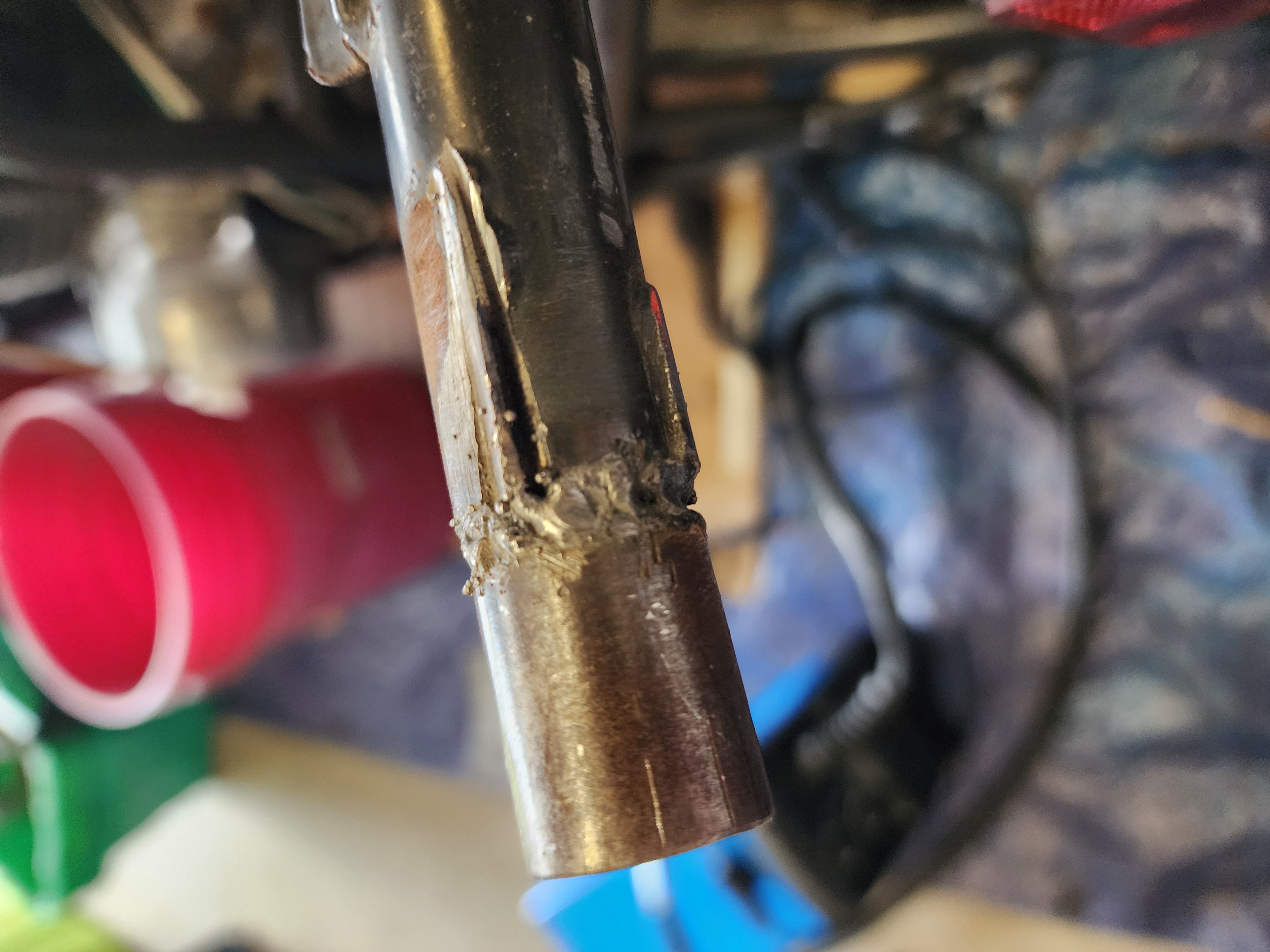 My first ever welds.
Next, I tack-welded the hoop to the frame, clamping it in place temporarily with vice grips.